

The pain-agitate-solution formula names a customer’s real problem, deepens the consequence of leaving it unsolved, then offers a solution mapped directly to that pain. For service businesses, it works because it shortens the gap between “someone finds your website” and “someone books a call.” The examples below cover homepages, ads, email, landing pages, social posts, and pricing tables, and they can be adapted this afternoon.
TL;DR:
- PAS should be used only when your audience already recognizes their pain, as agitation may seem pushy to unaware prospects.
- For channels with limited space, keep problem statements under 12 words in headlines and combine problem and agitation lines in ads to maximize impact.
- Every PAS draft must include evidence, a clear next step, and an honest limit on claims to maintain trust and conversion.
- Personalization works best early in the messaging but cannot fix unclear positioning or generic problems.
- Avoid over-agitation, vague solutions, and unverified claims to prevent losing credibility with your audience.
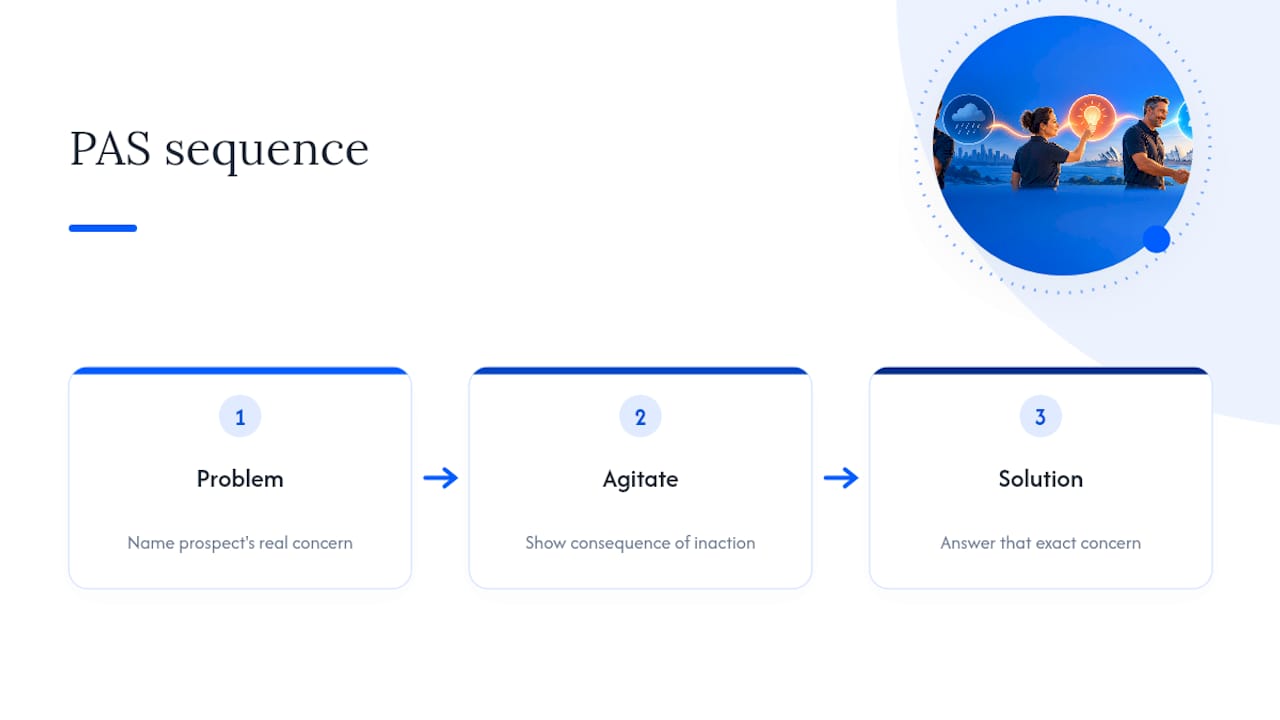
PAS breaks a sales message into three moves. Problem names what’s actually bothering your prospect, in their own words. Agitate extends that problem to its real consequence: the cost of doing nothing. Solution answers the exact problem you named, not a broader or unrelated one. The PAS Prompt Framework describes this middle step as the one that decides whether the message converts or feels like manipulation.
PAS works best when the reader already recognises the pain. A tradesperson who’s had three no-show quotes already knows the problem. A business owner who’s never thought about their website conversion rate doesn’t, so hitting them with agitation first will read as pushy. For that cold, unaware audience, a simpler explainer or educational hook usually beats PAS.
Channel matters too. On a homepage hero, PAS needs to fit above the fold in a headline and subhead. In paid ads, you’re often limited to one line for the problem and one for the solution. Email and SMS give you a subject line to hint at the problem and a body to agitate and resolve. Landing pages and pricing rows have more room to slow down and build the case. Before writing any of it, identify the specific problems your customers face using market research rather than guessing at pain points from your own assumptions.
Each example below tackles a pain point service businesses see constantly. Swap in your own numbers, timeframes, and outcomes, but keep the one-to-one link between the problem you name and the solution you offer.
Problem: “Visitors land on your website and leave within seconds because they can’t tell what you actually do.”
Agitate: Every day that copy stays vague, paid traffic and referrals bounce straight off the page.
Solution: “We write homepage copy that tells visitors exactly what you offer and what to do next, in the first five seconds.”
Adaptation tip: keep the problem line under 12 words for a hero headline. Save agitation for the subhead.
Problem: “Getting traffic but not enquiries?”
Agitate: “Every visitor who leaves without contacting you is a lead your competitor picks up instead.”
Solution: “Our lead-capture audit shows exactly where your funnel is leaking.”
Adaptation tip: ads have almost no room, so the problem and agitation often merge into one punchy line.
Subject: “Still chasing that quote follow-up?”
Opener (problem + agitate): “Most enquiries go cold after 48 hours without a reply. If you’re relying on memory to follow up, you’re losing bookings you already paid to generate.”
Solution: “Here’s a simple follow-up sequence that closes the loop automatically.” A structured follow-up cadence can carry this through to the booking.
Adaptation tip: put the problem in the subject line so it earns the open before you agitate in the body.
Problem: “Booking a consultation shouldn’t take five emails back and forth.”
Agitate: “Every extra step between interest and booking is a chance for someone to change their mind.”
Solution: “Pick a time that suits you, right here, and we’ll confirm in seconds.” Good landing page structure makes this solution visible without scrolling.
Adaptation tip: the solution line should describe the actual next click, not a vague promise.
Problem: “Ever hired a tradie and had no idea when they’d actually turn up?”
Agitate: “That uncertainty is why people put jobs off for months.”
Solution: “We text you a two-hour arrival window the night before, every time.”
Adaptation tip: social posts read better in conversational, question-led problem lines than formal statements.
Problem: “Worried our pricing looks steep next to a quick fix?”
Agitate: “Cheaper options often mean redoing the work in six months.”
Solution: “Our price includes a 12-month follow-up, so nothing gets left half-finished.”
Adaptation tip: pricing-page PAS works best as a short caption under the price, not a full paragraph.
Start with sentence templates you can fill in for any offer:
Run every draft through this checklist before it goes live:
Channel limits shape how much of this you can fit. A hero headline gives you roughly eight to twelve words for the problem, with the subhead carrying agitation. Search ads often cap headlines at 30 characters, so problem and agitation get compressed into one line and the solution becomes the display URL or call extension. Email preview text is your agitation line, since most inboxes show 40 to 90 characters before the subject cuts off.
Pro Tip: Show your personalised PAS variant early in the decision process, not buried three clicks deep. Research from the Australian National University found personalised messaging shown early gets considered and chosen more often than the same message shown late. That said, personalisation timing won’t rescue unclear positioning. Fix the message first, then worry about when to show it.
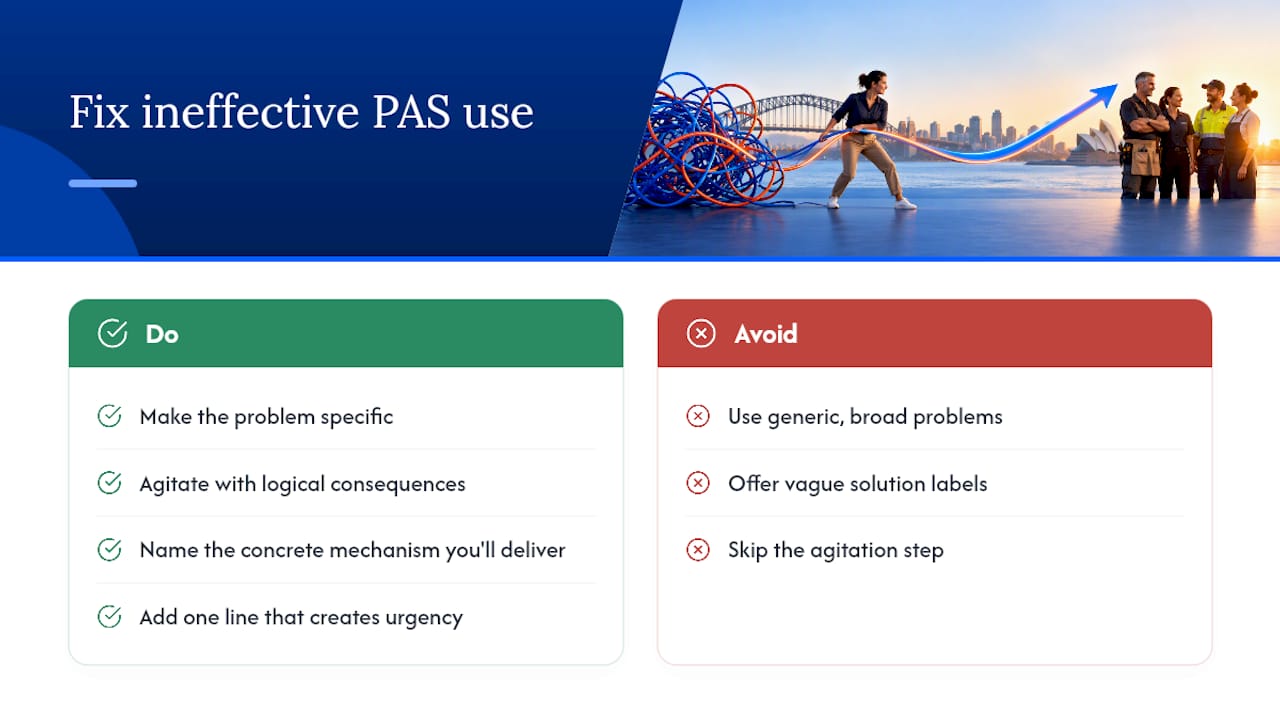
Four mistakes show up constantly in PAS copy. Over-agitation, where three sentences of manufactured dread replace one honest consequence, makes readers distrust the pitch. Vague solutions that don’t map back to the named problem feel like a pivot, and a solution that answers a different problem than the one it named reduces conversion. Skipping verification, no proof, no explanation of what happens after the click, leaves the reader to guess. And mistimed personalisation, showing a generic message after promising something tailored, breaks trust instantly.
Verification is the step most businesses skip. Before publishing, check:
Legal check for email and SMS: commercial messages must include working unsubscribe instructions and honour opt-out requests within five business days, with that unsubscribe option staying functional for at least 30 days. You need consent before sending, and you stay responsible even if a third party sends on your behalf.
A common failure looks like this: “Struggling with marketing? Marketing is hard and confusing and most businesses get it wrong. We offer full-service solutions.” The problem is generic enough to apply to anyone, the agitation adds nothing specific, and the solution is a vague label rather than a mechanism.
Rewritten with the PAS discipline: “Booked out this month but can’t explain why revenue hasn’t moved? Being busy and being profitable aren’t the same thing, and most service businesses don’t spot the gap until cash flow tightens. Our pricing review shows exactly where your margin is leaking.” Same topic, but now the problem is specific, the agitation follows logically, and the solution names what the reader actually gets.
Another common failure is skipping the agitate step entirely and jumping from problem to solution: “Website not converting? Book our website audit.” It’s not wrong, but it’s flat. Adding one line of consequence, “every week that page stays as is, you’re paying for traffic that leaves without booking,” gives the reader a reason to act now rather than bookmark it for later. A quick pass through the checklist for underperforming website elements usually surfaces where these gaps sit.
Writing a handful of PAS lines is one thing. Building a homepage, funnel, and ad set that all use the same disciplined structure is another, and that’s where most service business owners get stuck without ever seeing what a proper system looks like end to end.
Some workshops offer structured, step-by-step guidance rather than just templates. The Compelling Homepage Copy Workshop walks you through writing PAS-driven homepage sections line by line, and the #7 Lead Generation System Workshop (350 AUD per year) covers building the email and ad sequences that carry your PAS message from first click to booked call. Participants often receive templates, mentorship support, and extended access to materials beyond the initial workshop day.
If you’d rather adapt your own social creative around a PAS hook, tools like custom audio jingles can turn a strong problem statement into a memorable 15-second hero video opener. But the copy discipline has to come first. Start with the #1 Business Strategy Workshop (1,495 AUD per year) if you want the messaging, website, and lead generation pieces built as one connected system rather than three separate fixes.
Use PAS when your audience already recognises the problem, such as someone actively searching for a fix. For cold or unaware audiences who don’t yet see the pain, an educational or story-led approach usually outperforms PAS vs AIDA-style structures that assume more awareness upfront.
Give any homepage or ad variant enough traffic to produce a meaningful sample before judging it, generally a few weeks of consistent traffic rather than a few days. Testing one element at a time, the problem line or the solution line, makes it clearer which change actually moved bookings.
Yes, but you need consent before sending and a working unsubscribe option that honours opt-out requests within five business days and stays functional for at least 30 days. Keep the agitation honest rather than manufactured, since overly dramatic urgency in direct messages tends to trigger spam complaints and unsubscribes.
Pull the exact phrases your customers used to describe their problem from reviews, enquiry forms, or sales calls, then use that language directly in the Problem slot instead of paraphrasing it into marketing speak. A tradesperson’s customer and a consultant’s customer describe frustration differently, so the same underlying pain needs different wording for each segment.
PASO adds an Outcome step after Solution, spelling out the specific result the reader gets, such as “book more consultations without chasing follow-ups.” It suits longer formats like landing pages or pricing sections where you have room to show the solution and then paint the after-state, while short formats like ads usually stick to the three-part PAS structure.