

Retargeting works for service businesses when it’s built to recover genuine enquiries rather than chase impulse clicks. It suits low-frequency, high-consideration purchases like legal advice, home renovations or health services, where people rarely convert on the first visit. The catch: you need working analytics, page-level tracking, and a proper consent mechanism before you spend a dollar. Get those three things sorted, map your highest-value pages, and start with one channel.
TL;DR:
- Retargeting is most effective for service businesses when focused on recovering genuine inquiries rather than impulse clicks, especially on pages indicating high intent.
- Combining social retargeting for awareness with search retargeting for active intent, supported by email remarketing, yields the best return on investment.
- Proper setup requires auditing key pages, segmenting audiences by action, and timing windows aligned with the typical decision cycle of the service.
- Privacy compliance in Australia mandates clear consent, privacy disclosures, and regular pixel audits, particularly for health or sensitive services.
- Cost efficiency depends on starting small, tracking key metrics like cost per lead and booking rate, and adjusting spend based on actual client value and audience response.
Retargeting shows ads to people who’ve already visited your website or engaged with your business, using a tracking pixel or tag that “tags” a visitor’s browser so platforms like Meta or Google can recognise them later. Remarketing is the same idea, just often used interchangeably, though some marketers reserve “remarketing” specifically for email sequences sent to existing contacts. Technically, it works like this: a snippet of code fires when someone lands on your site, drops a cookie or matches an identifier, and adds that person to an audience list you can then target with ads.
Service businesses benefit more than most from this approach because of how people actually buy. Nobody hires a physiotherapist, a family lawyer, or a landscaper on their first Google search. They compare, they hesitate, they get distracted by a phone call, and they forget to come back. That gap between interest and booking is exactly where retargeting earns its keep.
Set your expectations correctly from the start:
Different channels do different jobs, and the right mix depends on your service, your budget, and how long your typical buying decision takes. Here’s how the main types stack up.
Most service businesses get the best return from combining social retargeting for awareness with search retargeting for intent, backed by an email sequence for the leads who never quite booked.
Building a retargeting system properly takes an afternoon of planning before you touch a single ad account. Rushing this step is the single biggest reason campaigns underperform.
Pro Tip: Start with one channel and one audience segment rather than launching display, search and social retargeting simultaneously. Learning what works on a single channel first means you’re not guessing which variable moved the needle when something improves. This mirrors what regulators themselves note about pixel management: businesses that keep their tracking setup simple are also the ones best placed to audit it properly.
Running retargeting ads means collecting and using personal information, and that puts you squarely inside Australia’s privacy framework. The Office of the Australian Information Commissioner (OAIC) requires organisations to audit their tracking pixels, disclose pixel use clearly in their privacy policy, and offer a simple opt-out for targeted advertising under Australian Privacy Principle 7 (APP 7), which governs direct marketing.
This isn’t a box-ticking exercise. The OAIC has already found privacy breaches where tracking pixels on a health-related website collected sensitive information, and concluded that express consent is required when a pixel might capture sensitive categories of data. If you run a health, counselling, or family law service, be especially cautious due to privacy rules around sensitive information.
For email and SMS remarketing, the ACMA recommends express consent for telephone, SMS and email marketing, with clear terms explaining how that consent is collected, used, and withdrawn. The Spam Act also catches automated transactional emails that slip in marketing content, and unsubscribe requests must be actioned quickly, not buried in a support queue.
Practically, here’s what to put in place:
None of this is optional overhead bolted onto marketing. It’s the foundation that keeps your retargeting program lawful and your client relationships intact.
Tracking the right numbers is what separates a retargeting program that improves over time from one that quietly burns budget. Business is a good starting reference for setting realistic, testable targets.
Your primary KPIs should be:
Supporting metrics worth watching include landing-page conversion rate, assisted conversions (where retargeting helped close a sale that started elsewhere), time-to-contact after a form submission, and lifetime value where you can track it. Full KPI definitions and worked examples are covered in this breakdown of marketing KPIs for service businesses.
Set targets based on your own historical numbers, not a competitor’s screenshot, and use A/B testing on creative and timing windows to improve results gradually. Connecting your ad platforms to your CRM or booking system is what makes attribution reliable. Without that link, you’re guessing which ad actually drove the phone call.
Concrete examples save you from staring at a blank campaign builder. Here are three sequences worth adapting to your own service.
Pro Tip: Keep your ad copy structure simple: one headline that names the problem, one line of social proof, and one clear call to action. Overloading a retargeting ad with three offers and two testimonials usually confuses people who are already halfway convinced.
Retargeting only works when the fundamentals underneath it are solid, which is exactly where Mybworkshops focuses its structured, three-phase mentoring approach. Rather than teaching ad tactics in isolation, the program pairs personal mentorship with practical AI tools so business owners build a real marketing engine, not a scattered set of campaigns.
The 7 Step Diagnostic for fixing underperforming Facebook ads is a good example of this in practice: it walks through the pixel, tracking, and conversion issues that quietly sabotage retargeting before an owner even realises. Mybworkshops prioritises first-party data and measurable KPIs like booking rate and cost per lead over vanity metrics like reach or impressions, because those are the numbers that actually connect to revenue.
Retargeting is genuinely one of the more cost-efficient parts of a paid ad account, because you’re spending on people who already know you rather than paying to introduce your business to strangers. That doesn’t mean it’s free to run well.
Start small and treat your first month as a learning phase rather than a growth phase. A modest daily budget split across a single audience segment on one channel gives you enough data within a few weeks to see which timing window and creative style actually gets responses. Scaling spend before you’ve validated that is how businesses burn through budget on an untested assumption.
Watch your cost per lead against your service’s typical client value. A $2,000 renovation project can absorb a higher cost per lead than a $150 consultation, so your budget ceiling should flex with what a converted client is actually worth to you. Reinvest in whichever segment or window produces the lowest cost per booked appointment, and pull back on the ones that don’t, rather than spreading spend evenly out of habit.
Frequency caps also protect your budget, not just your brand. Showing the same person an ad fifteen times a month wastes spend on diminishing returns instead of reaching someone new. Pair retargeting with a modest prospecting budget too. A retargeting-only strategy eventually runs out of people to show ads to, since your audience pool only grows as new visitors arrive through other channels like search or content marketing.
Most retargeting problems trace back to a handful of repeat mistakes, and recognising them early saves a lot of wasted spend.
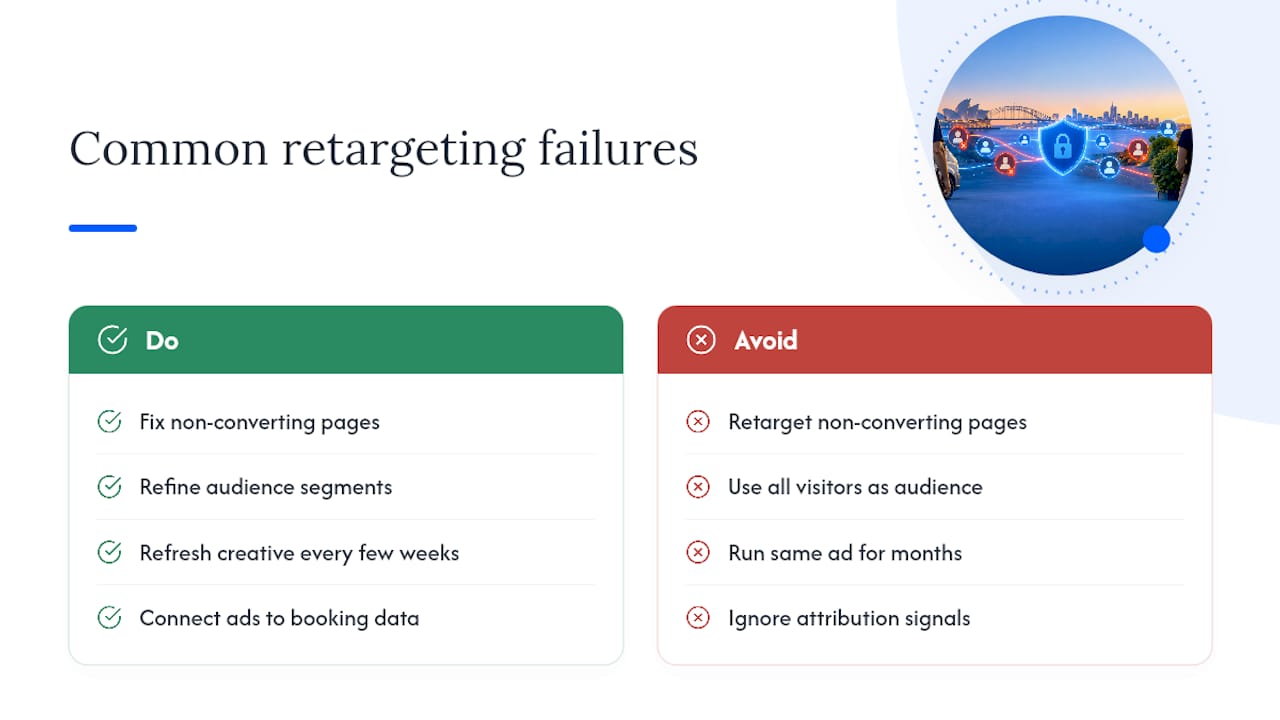
The most common failure is retargeting a website that doesn’t convert in the first place. If your service pages are vague, your calls to action are buried, or your booking process is clunky, no amount of ad spend fixes that. Retargeting amplifies what’s already there, good or bad.
Another frequent issue is audiences that are too broad or too small. A pixel audience built from every single website visitor, including people who bounced in two seconds, dilutes your ad spend on people who were never close to booking. On the flip side, an audience segment that’s too narrow runs out of reach within days and stops delivering impressions altogether.
Watch for creative fatigue too. Running the same ad for months causes performance to decline even with a healthy audience, simply because people stop noticing it. Refresh creative every few weeks, particularly in your early-window sequences where first impressions matter most.
Attribution confusion trips up a lot of service businesses as well. If your ad platform and your booking system aren’t connected, you’ll misjudge which campaign actually drove a result and cut a channel that was quietly working. Finally, watch your exclusions. Continuing to show ads to someone who already booked wastes budget and can come across as careless, which undercuts the trust you were trying to build in the first place.
Retargeting works best as one gear in a larger machine, not a standalone tactic bolted onto a website. It performs strongest when it’s fed by other channels rather than left to find its own traffic.
Content marketing and organic search are what bring new visitors into your retargeting pool in the first place. A blog post, a well-optimised service page, or a helpful guide gives people a reason to land on your site before you ever show them a follow-up ad. Businesses that pair retargeting with organic SEO efforts tend to build a steadier, cheaper stream of prospects than those relying on paid traffic alone.
Email marketing and retargeting should reinforce each other rather than compete for the same message. If someone’s already receiving a nurture email sequence after downloading a guide, your retargeting ads can pick up a different angle, like social proof or a specific service benefit, instead of repeating the same line they’ve already read in their inbox.
Your website itself needs to carry the weight once someone clicks through. A retargeting ad that promises a straightforward next step but lands on a slow, cluttered, or unclear page loses the person you just paid to win back. That’s why positioning and messaging work matters as much as the ad itself. Getting your core value proposition right on the page the ad points to often lifts conversion more than any change to the ad creative.
The mechanics stay the same, but the tone, timing, and compliance weight shift depending on what you’re selling.
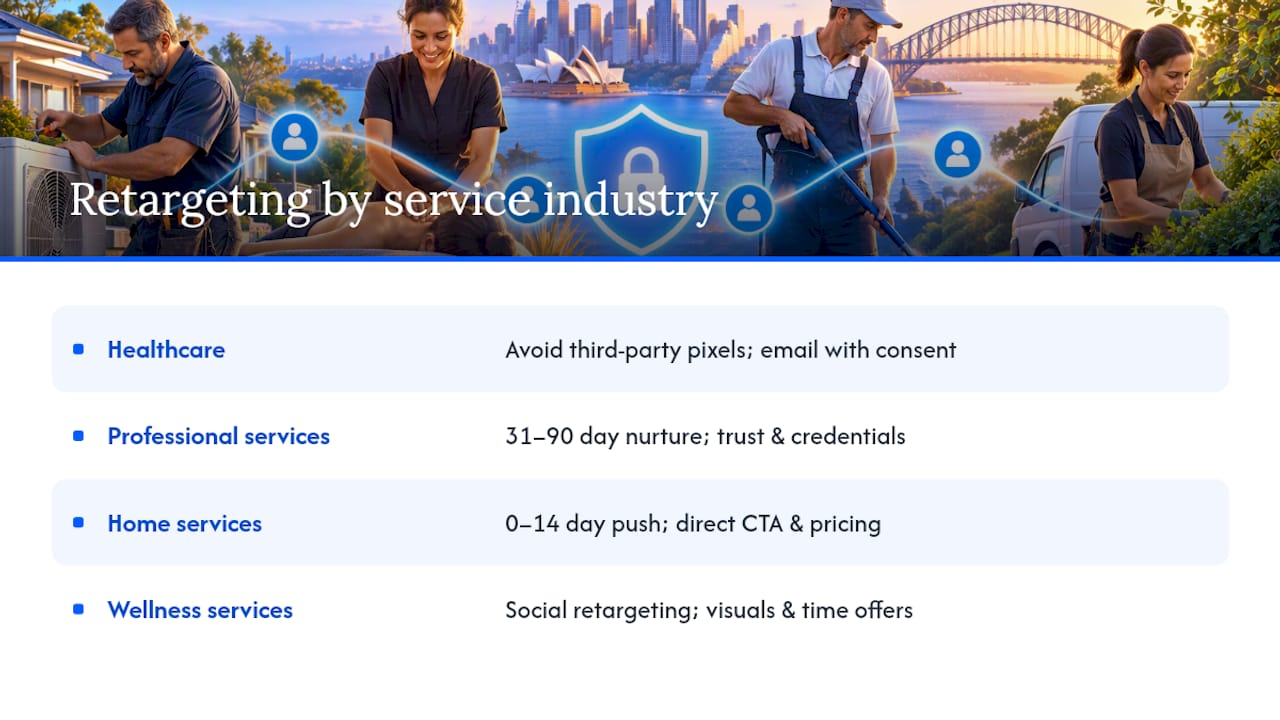
Healthcare and allied health services need the most caution. Given the OAIC’s findings on pixels capturing sensitive health information, many practices are better served avoiding third-party pixel retargeting altogether and relying instead on email remarketing to existing patients with clear, documented consent.
Professional services like legal, accounting, or financial advice usually have longer decision cycles, so a 31 to 90 day nurture window with trust-building content, credentials, and case outcomes tends to outperform an aggressive, short-window push.
Home services such as trades, cleaning, or landscaping often convert faster, sometimes within days, so a tighter 0 to 14 day sequence with a clear, direct call to action and pricing transparency usually performs better than a slow-burn trust campaign.
Wellness and personal services like fitness studios or beauty clinics respond well to social retargeting with strong visual proof and time-limited offers, since these decisions are often driven by mood and timing as much as research.
Whatever your industry, the underlying principle doesn’t change: match your sequence length and message tone to how your actual clients make the decision to book.
If you want a structured way to work through this alongside your broader marketing plan, the Lead Generation System Workshop (350 AUD per year) walks through building the funnel that retargeting sits inside, rather than treating ads as a fix in isolation. For businesses wanting the fuller picture, from messaging through to website structure and lead systems, the complete workshop catalogue covers each stage in sequence.
Before running any campaign, review the OAIC’s tracking pixel guidance, the ACMA’s consent expectations, and Google’s consent mode setup documentation. These cover the legal and technical basics every service business needs before spending a dollar on ads.
A common example is a visitor browsing your service page without booking, then seeing a follow-up ad on social media a few days later featuring a client testimonial and a “book your consultation” button. Another is emailing someone who abandoned a contact form halfway through, reminding them to finish and offering a simple next step.
There’s no single best channel. The strongest results usually come from combining organic search, a converting website, and retargeting that recovers people who almost booked but didn’t. Retargeting works best layered on top of solid SEO for lead generation, not as a replacement for it.
Yes, retargeting remains effective, though it now depends more on first-party data and consented audiences as privacy rules tighten. Email lists and CRM-based remarketing are becoming more reliable than broad third-party pixel audiences for high-value service leads.
Costs vary widely depending on your industry, platform, and audience size, so there’s no fixed figure that applies across every service business. A sensible approach is starting with a small daily budget on one channel, tracking cost per lead and cost per booked appointment closely, and scaling only once those numbers prove out.