

This article gives you a ready-to-use bank of lead qualification questions grouped by sales stage, along with the BANT, CHAMP and MEDDIC frameworks to choose from, a simple CRM scoring model, and copy-ready scripts. Jump to the question bank if you want templates now, or read on for how to pick the right framework and avoid the phrasing traps that skew your data.
TL;DR:
- Most small and mid-sized businesses should combine different frameworks like BANT, CHAMP, and MEDDIC based on sales complexity and decision-maker involvement.
- Qualification questions must be asked in the right order, starting with broad pain points before narrowing down to budget and authority to avoid leading answers.
- Using a simple CRM scoring system based on pain, authority, timeline, and fit helps prioritize leads for immediate follow-up or nurturement.
- Asking about the cost of inaction and decision stakeholders early improves accuracy in gauging urgency and decision process.
- Qualification questions should be integrated into forms, scripts, and follow-up cadences to ensure consistent, non-intrusive prospect engagement.
Before you write a single question, decide what you’re actually trying to learn. That choice depends on how complex your sale is and how many people need to say “yes” before a deal closes.
BANT (Budget, Authority, Need, Timeline) is the oldest and simplest of the three. It works well for shorter, more transactional sales where one person usually makes the call and the offer is easy to understand. If you’re selling a single product or a fixed-scope service, BANT gives you a fast way to check whether someone can buy, wants to buy and will buy soon.
CHAMP (Challenges, Authority, Money, Prioritisation) flips the order. Instead of opening with budget, it opens with the prospect’s problem. That small change matters: leading with challenges gets people talking honestly before they feel like they’re being sized up for a sale. CHAMP suits businesses where the buyer might not fully understand their own problem yet, which is common in service industries where the client knows something’s wrong but hasn’t diagnosed it.
MEDDIC (Metrics, Economic Buyer, Decision Criteria, Decision Process, Identify Pain, Champion) is built for longer, more consultative B2B sales with multiple stakeholders and a formal buying process. It asks you to map out who the economic buyer is, what criteria they’ll judge you against, and who inside the business will champion your solution when you’re not in the room. A QUT review of B2B sales tactics found that stakeholder management and communication are among the most critical tactics in pursuing larger deals, which is exactly what MEDDIC is designed to surface.
In practice, most small and mid-sized businesses don’t run one framework in isolation. They borrow:
The frameworks are lenses, not scripts. What matters is that you’re consistently asking about need, authority, timeline and fit, in whatever order suits the conversation. If you’re still working out who your best-fit customer actually looks like, it’s worth defining your ideal customer profile first: qualification questions only work well when you know what a “yes” is supposed to look like.
Use these as a starting list and adjust the wording to match how your team actually talks. Each group serves a different job, so don’t fire them all off in one breath.
Opening and pain questions work best on a discovery call or a warm email, where tone matters and you can read the response. Budget, authority and technical fit questions suit a form or a qualifying email, where a structured answer is easier to score. Next-step questions belong at the very end of every interaction, no matter the channel: a call, demo or form that doesn’t end with a clear next action is a lead that quietly goes cold.
The order you ask questions in matters almost as much as the questions themselves. Start broad and open-ended (“Tell me what’s been happening”) before you narrow to specifics (“So the main issue is response time, is that right?”). Closed questions are useful for confirming what you’ve already heard, not for opening the conversation, because they invite a one-word answer before you’ve built any context.
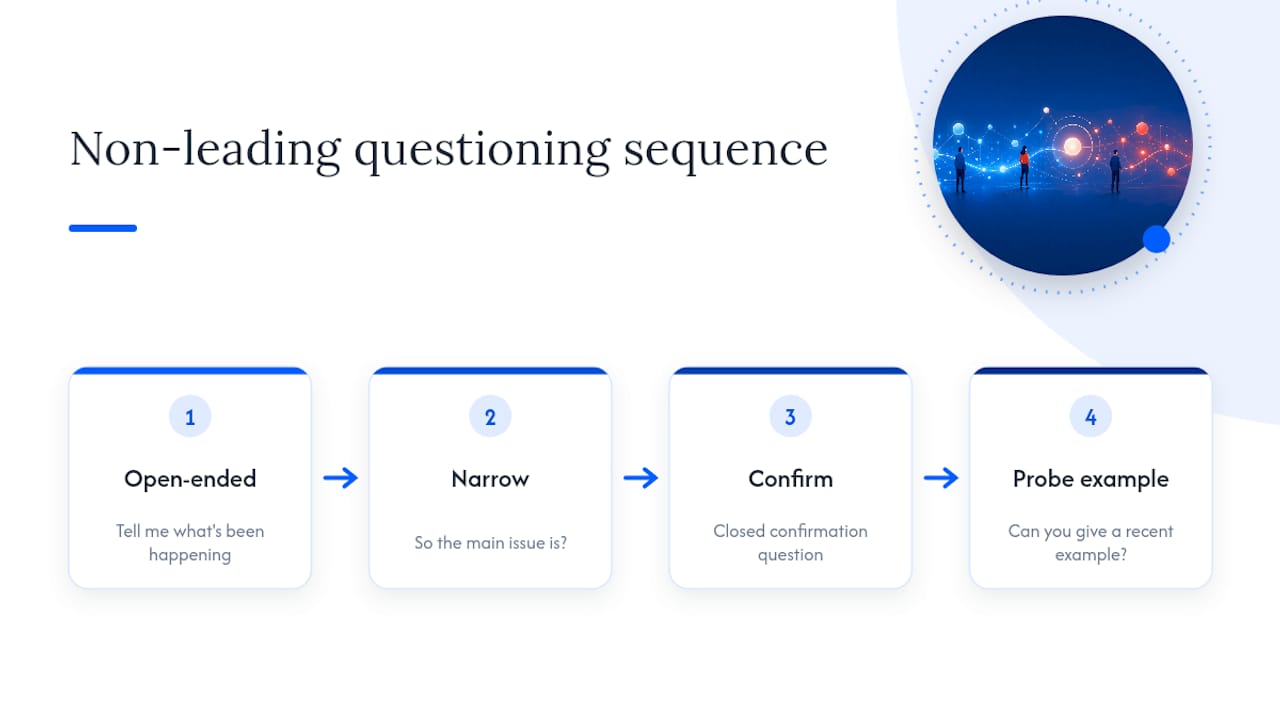
Budget and authority are the two topics people are most guarded about, so frame them as options rather than direct asks. “Are you exploring a range, or do you have a figure locked in?” feels less confronting than “what’s your budget?” and usually gets a more honest answer. The same goes for authority: “who else usually weighs in on decisions like this?” reads as curious rather than as a test of whether the person in front of you actually matters.
When a prospect gives you a vague answer, a short, specific probe turns it into something you can act on. A technique used in academic survey interviews is to follow a general statement with “can you give me a recent example?”, which pulls a fact out of a feeling.
Questionnaire design research also warns against leading or loaded questions, phrasing that nudges the respondent toward an answer you want to hear. Presenting response options in a neutral, meaningful order rather than stacking the “best” answer first reduces this bias, and the same principle applies whether you’re writing a form field or a script for a call.
Pro Tip: Ask your budget and authority questions after you’ve already established the pain, not before. People answer sensitive questions more openly once they feel understood.
A question bank is only useful if the answers end up somewhere your team can act on. Set up your CRM to capture two things for every qualifying conversation: discrete fields you can score (budget range, timeline, authority level) and short verbatim notes that preserve context a dropdown can’t. Treating qualification as an ongoing learning loop rather than a one-off form means leads who aren’t ready today can still be nurtured and requalified later, instead of falling out of the pipeline entirely.
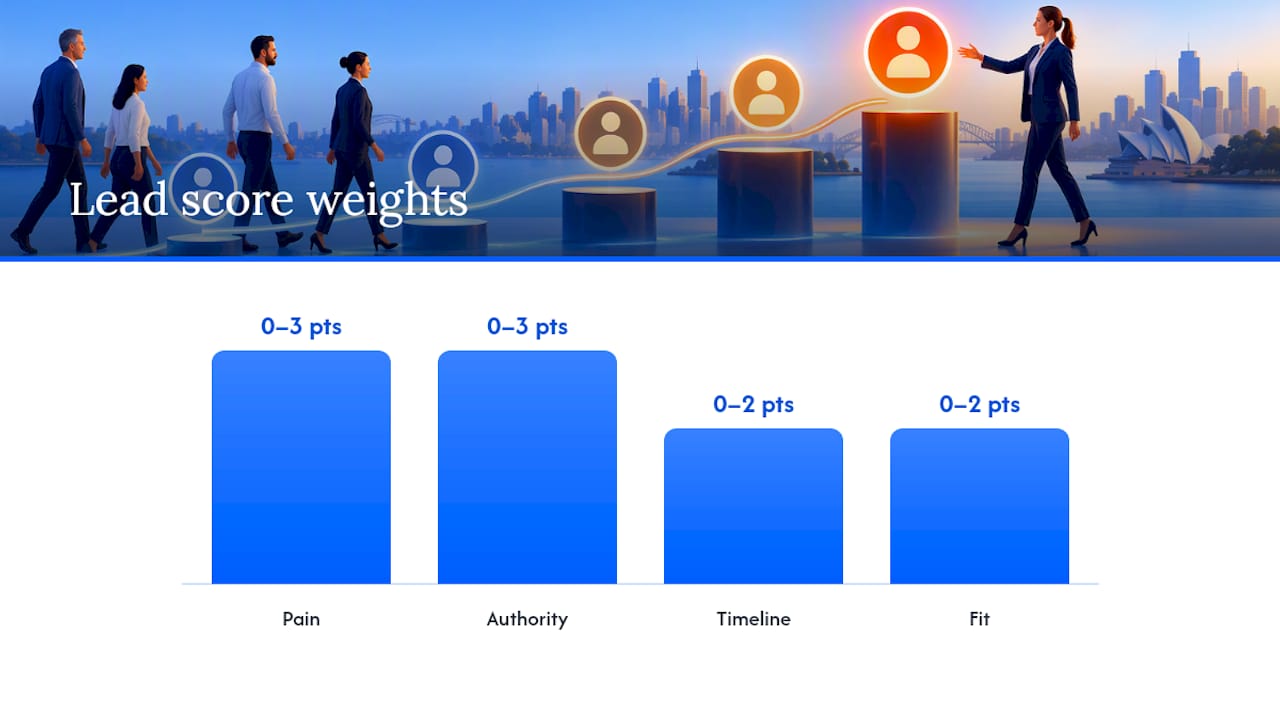
A simple scoring model works better than an elaborate one, at least to start:
A lead scoring 7 or more out of 10 goes straight to a sales follow-up call. A lead scoring 4 to 6 goes into a nurture sequence with a check-in scheduled in four to six weeks. Anything below 4 stays on a low-touch email list. Say a prospect describes a costly, specific problem (3), is the sole decision-maker (3), wants to start next month (2) but is a rough fit for your ideal customer (0): that’s 8 out of 10, and it should land on a salesperson’s desk that day, not in a queue.
Understanding the difference between a lead and a prospect helps here too, since not every enquiry deserves the same scoring weight or urgency.
Loaded questions are the most common mistake: “wouldn’t it be great to finally fix this?” invites agreement rather than honest information, and the answer you get back tells you nothing useful. Ask what’s happening, not whether the prospect agrees with your framing of it.
Consent matters too. The ACCC’s review of unsolicited selling and lead generation warns that these practices can cause real consumer harm, and recommends clearer consent at the point of contact. Under Australian Privacy Principle 7, the OAIC requires a simple opt-out on every direct marketing contact and current, specific consent before you follow up. Build both into your forms and scripts from the start, not as an afterthought.
Adapt the wording, keep the structure.
Reading a question bank is one thing. Building it into your forms, your call scripts and your CRM so it actually runs week after week is another. That’s the gap our #7 Lead Generation System Workshop is built to close, at 350 AUD per year.
The workshop walks you through mapping your own qualification questions to your CRM fields, building the scoring rules that suit your sales cycle, and setting up the follow-up cadences that keep not-yet-ready leads warm instead of letting them go cold. You leave with templates you can put to work the same week, not another set of ideas to file away. It sits alongside personal mentorship and the practical, hands-on templates that run through every MYB Workshops programme, rather than replacing your judgement with a generic playbook.
If you’re still working out whether more leads or better-qualified leads is the real fix for your pipeline, our #1 Business Strategy Workshop is a useful starting point before you build out the lead generation system itself.
Strong qualifying questions cover need (“what’s driving this now?”), authority (“who else is involved in this decision?”), timeline (“where does this sit against your other priorities?”) and budget (“have you set aside a range for this?”). The question bank above groups these by sales stage so you can match the question to the moment in the conversation.
There’s no single agreed “5 W” framework specific to sales qualification; the term is more commonly associated with journalism and general problem-solving (who, what, when, where, why). In a sales context, those same prompts map naturally onto qualification questions: who’s involved, what’s the problem, when do they want it solved, where does it sit against other priorities, and why now.
Most frameworks, including BANT, CHAMP and MEDDIC, come back to the same core criteria: need or pain, budget or economic reality, authority to decide, and timeline. MEDDIC adds decision criteria and a named champion for more complex, multi-stakeholder sales.
Start with open, broad questions about the prospect’s problem before narrowing to specifics like budget and authority, and always end with a clear next step rather than leaving the conversation open-ended. Record answers as both discrete CRM fields and short notes, then use a simple scoring model to decide whether the lead goes to a salesperson now or into a nurture sequence.