

Community led learning is peer and cohort-based professional development where service business owners work alongside expert facilitators to solve real marketing, website and branding problems together. For a solo operator or small team, it beats passive courses because you get structured tasks, peer feedback and accountability instead of another video library you never finish. The rest of this guide covers the formats, what a good programme includes, how to pick one, and where the evidence for it comes from.
TL;DR:
- Community-led learning produces tangible results by ensuring participants complete real deliverables, such as websites or funnels, by the end of each session.
- Structured programs follow a three-phase rhythm of assess, implement, and embed, with specific tasks and tools provided for each step to ensure progress.
- Cohort size should ideally be between eight and fifteen to allow effective peer feedback without overwhelming participants or creating long queues.
- Good programs include clear outcomes for each session, access to templates and resources, and scheduled follow-up support to maintain momentum.
- Paid programs like MYB Workshops align with these principles, offering expert-led, task-oriented sessions with long-term access to materials and community support.
In practice, this style of learning takes a handful of recognisable shapes, and each one produces something you can actually use by the end.
Picture a physiotherapist who joins a cohort to rewrite her homepage copy: by the end of the session she has a working draft, not a checklist of “things to consider.” Or an electrician who uses a masterclass on lead generation to build his first lead magnet and a simple funnel to collect enquiries. The deliverable is the point, not the discussion.
Passive video courses ask you to absorb information alone and hope you apply it later. Community led formats force the application while the ideas are still fresh, which is the biggest practical difference.
Peer feedback catches blind spots a solo learner misses entirely. Someone else in your cohort will spot the vague headline on your services page or the missing call-to-action before you launch it. Accountability, even informal, keeps projects from stalling once the workshop ends. Group settings also open doors: you swap referrals, compare notes on suppliers, and get honest opinions on pricing and positioning from people outside your own head.
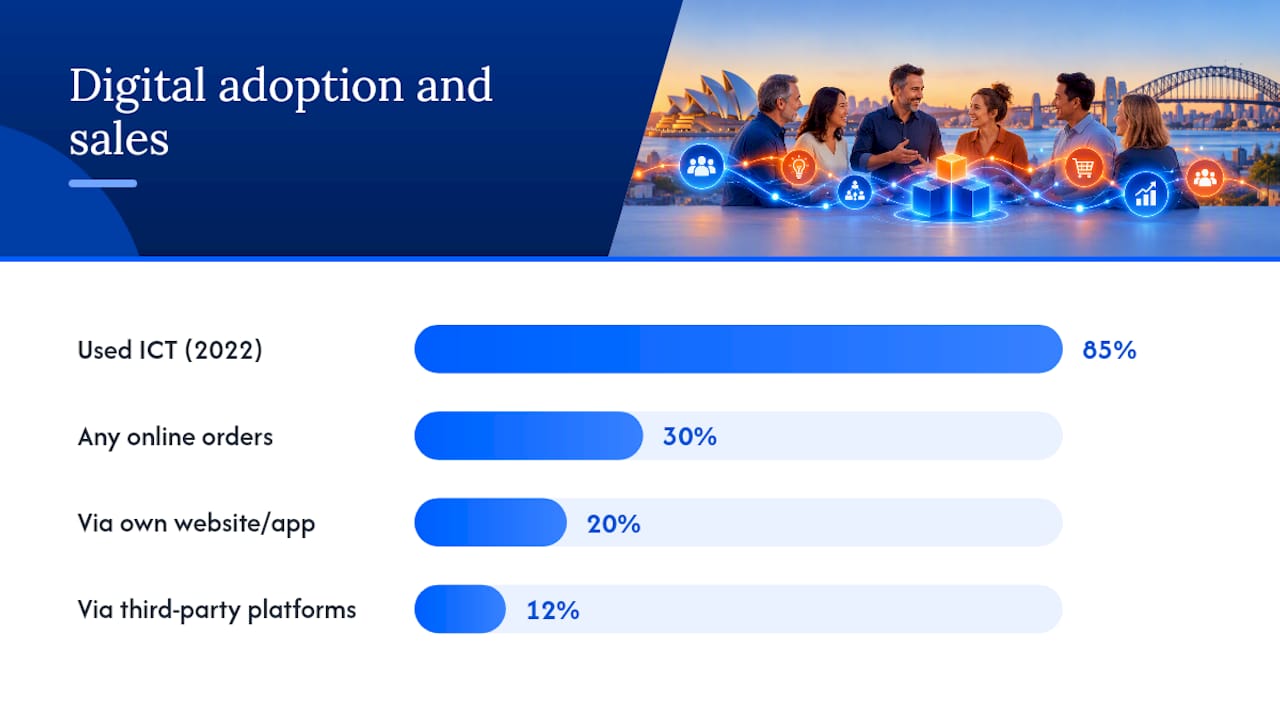
There is a genuine skills gap worth addressing here. ABS data shows 85% of Australian businesses reported using ICT in the year to 30 June 2022, yet only 30% received online orders, 20% via their own website or app and 12% through third-party platforms. That gap between having the technology and actually converting through it is exactly where implementation-focused, community-based education earns its keep.
Owners who go through structured, peer-supported programmes commonly report:
These are typical outcomes reported by participants, not guarantees. Results still depend on how consistently you apply what you build.
A programme that produces real change usually follows a recognisable rhythm rather than a random string of topics.
Good delivery combines live facilitation with small peer review groups, so feedback is specific rather than generic. Expect a workbook or template for each core exercise, and a realistic weekly time commitment, usually a couple of hours between sessions to complete tasks.
Pro Tip: Ask how many people are in each cohort before you enrol. A group of eight to fifteen tends to give you enough varied feedback without turning peer review into a queue you never get through.
Before handing over money, run any programme through a short checklist. Look for a curriculum mapped to specific tasks (not just topics), a facilitator with real operating experience, a sensible cohort size, and genuine access to templates or resources you keep afterwards.
Ask providers directly:
Watch for red flags too. An open forum with no facilitation is a chat group, not a learning programme. Vague claims like “grow your business” with no specifics about deliverables are a warning sign, and so is a programme with no follow-up or templates once the live session ends.
Designing a cohort for implementation means setting an explicit deliverable per session, pairing owners for peer feedback, and scheduling follow-up office hours to keep momentum. That mechanic, more than the topic itself, is usually what separates a genuine learning programme from an expensive chat.
The skills gap identified in the ABS Digital Intensity work is not evenly spread. Micro and small businesses tend to lag on the digital skills side of the equation even as broader ICT adoption climbs, which is exactly why structured, hands-on formats matter more than another general awareness campaign.
Two government-backed pathways illustrate what this looks like when it works well.
| Programme | What it offers | Format |
|---|---|---|
| Digital Solutions | Free workshops and low-cost one-to-one digital advisory covering social media, digital marketing, AI, cybersecurity and website improvements | Cohort workshops plus 1:1 advisory |
| Industry Growth Program and incubator evaluations | Mentoring, workshops and network connections, with participants reporting improved performance and expanded networks | Mentoring and structured learning events |
An evaluation of incubator learning events found participants consistently point to mentoring, workshops and the networks they built as the most valuable parts of the experience, with anecdotal reports of stronger business performance afterwards. These government pathways are a sound entry point, especially if you want to test the format before committing to a paid, expert-led alternative.
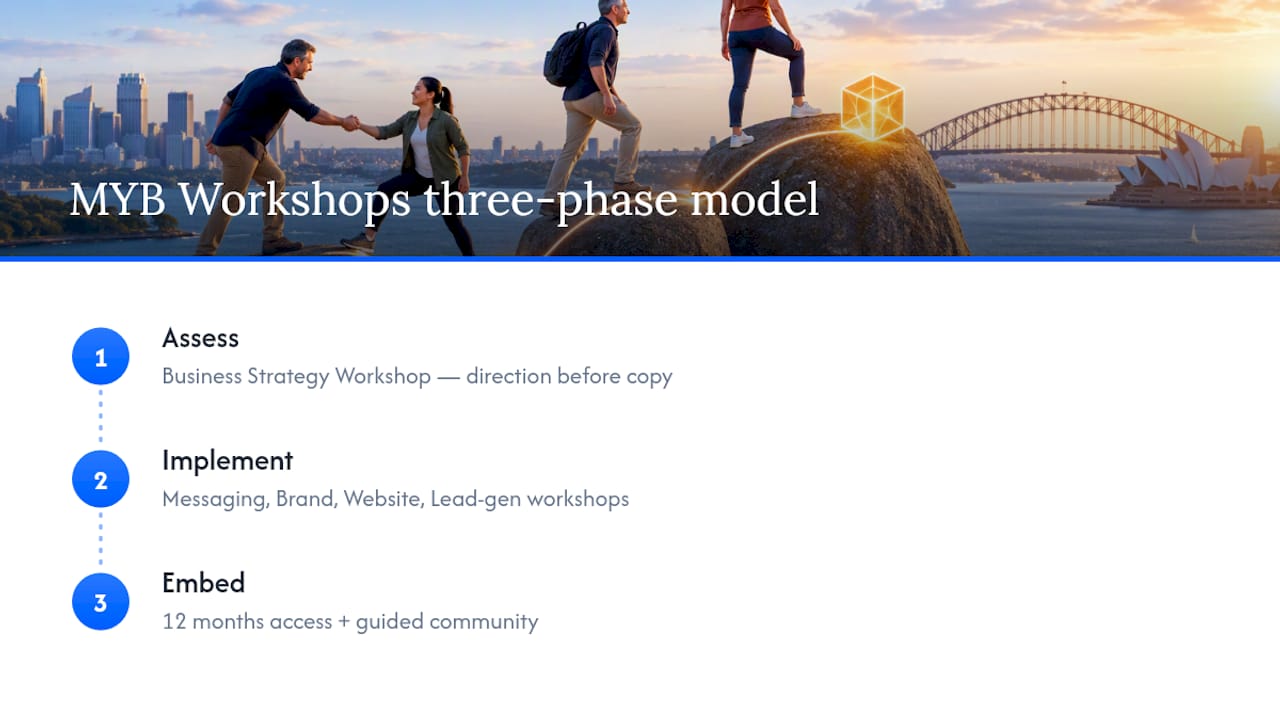
If that structure, assess, implement, embed, sounds like what you have been missing, it is the exact model behind Mybworkshops. Rather than sitting through another generic webinar, you work through a three-phase, expert-led program that pairs personal mentorship with hands-on templates, so you leave each session with something built, not just notes.
The programme lineup maps directly onto the checklist covered above. The Business Strategy Workshop covers the assess phase, giving you direction before you touch a single page of copy. From there, workshops on messaging, brand identity, website conversion and lead generation carry you through implementation with real templates and AI prompts rather than theory. Buyers get 12 months of access to materials and a guided community for the embed phase, so the work doesn’t stall once the live session ends.
Every workshop is sold individually or as part of a bundle, so you can start with the piece your business needs most. Browse current workshop dates and topics to see what fits your calendar this month, or start with the Business Strategy Workshop if you are not yet sure where your priorities lie.
For readers who want to start with free or low-cost options before committing to a paid cohort, Digital Solutions offers workshops and advisory support, while the Small Business Mentoring Service connects owners with experienced volunteer mentors. The ABS Digital Intensity Index is worth a look if you want the fuller picture on where small business digital skills sit nationally, and structured sales-focused cohort programs show how the same peer-learning mechanics apply beyond marketing.
Community led learning is peer or cohort-based professional development where a group works through structured tasks with an expert facilitator, rather than consuming content alone. For service businesses, it usually centres on marketing, website or brand projects with a finished deliverable at the end of each session.
It tends to produce faster, more consistent results because peer feedback and accountability catch mistakes and stalled progress that solo learners often miss. A well-run Digital Solutions workshop or paid cohort still depends on you showing up and doing the work between sessions.
The Business Strategy Workshop and the Lead Generation System Workshop are priced differently; see the workshops page for current pricing. Other workshops, including messaging, brand identity, website conversion and SEO, are listed on the workshops page with current pricing.
The Digital Solutions program offers free workshops and low-cost advisory sessions covering website improvements, social media and digital marketing. State programs such as Business Victoria run similar cohort-based sessions on specific topics.
Turn up with a specific problem you want solved, whether that’s a homepage rewrite or a lead magnet, rather than a vague interest in “marketing.” Complete the between-session tasks promptly, since the peer feedback only works if you bring something for the group to react to.