
This article gives you five ready-to-use service description examples, plus fill-in-the-blank templates, so you can write pages that explain what you do, who it’s for, and what happens next. Every example is built for service pages, not product listings, and each one comes with a quick legal and accessibility check so your finished copy is honest, clear, and usable by everyone who lands on it.
TL;DR:
- Effective service descriptions must start with the customer’s problem and the outcome they desire, not the provider’s qualifications or features.
- Use short, descriptive headings and short paragraphs that are easy to scan, with a single clear call to action for each page.
- Incorporate genuine customer language and unprovable claims should always be backed by evidence and accompanied by specific timeframes or results.
- Avoid jargon, vague headings, and false testimonials; ensure all claims are truthful, verifiable, and compliant with advertising laws.
- Regularly test and adapt your pages by including concrete details and ensuring accessibility for screen reader users.
A good service description starts with the customer’s problem, not your qualifications. Open with what’s going wrong for them and what life looks like once it’s fixed: that’s your thesis statement, and everything else on the page supports it.
Structure matters almost as much as the words. Visitors scan before they read, and short, scannable sections with clear calls to action consistently perform better than dense blocks of text. Average time on a small business website is brief, typically two to three minutes per session, so your page needs to make its point fast.
A few things to get right every time:
Each example below has four parts: a headline (problem plus outcome), an outcome line, a short body, and an exact CTA. Swap the bracketed details for your own, and replace any generic adjective with something provable, a response time, a qualification, or years spent serving a particular type of client.
Business coaching or advisory. Headline: “Stuck at the same revenue for two years? We help service business owners build a plan that actually moves the needle.” Outcome line: “Most clients leave our first session with three changes they can make this week.” Body: “You’ve tried the courses and the templates. What’s missing is someone who knows your numbers and asks the right question before you spend another dollar on ads.” CTA: “Book a 15-minute discovery call.”
Trades (electrician, plumber, builder). Headline: “Power dropping out at the worst times? We find the fault and fix it properly, not just patch it.” Outcome line: “Licensed, insured, and we show up when we say we will.” Body: “No call-out surprises. We quote the job before we start, and we explain what we found in plain English.” CTA: “Get a tailored quote.”
Therapy or wellbeing. Headline: “Feeling overwhelmed and not sure where to start? Our sessions give you a clear, private space to work through it.” Outcome line: “Goal: steadier weeks, fewer spirals, tools you can use between sessions.” Body: “You don’t need a diagnosis to book in. Many clients come simply because something feels off and they want support figuring out what’s next.” CTA: “Start your free discovery call.”
Bookkeeping or accounting. Headline: “Behind on reconciliations and dreading tax time? We get your books current and keep them that way.” Outcome line: “Monthly reporting delivered by the 10th, every month.” Body: “You’ll know your numbers without chasing anyone for them. We flag issues before they become expensive ones.” CTA: “Book a 15-minute discovery call.”
Website or design services. Headline: “Website not converting visitors into enquiries? We rebuild the pages that matter most.” Outcome line: “Goal: clearer messaging, a single CTA per page, and a site that works on mobile.” Body: “We start with your current traffic and your customers’ actual words, not a template pulled from somewhere else.” CTA: “Get a tailored quote.”
Keep the aspirational lines labelled as goals, not guarantees. Saying “goal: steadier weeks” is honest, saying “we fix anxiety” is a promise you probably can’t back up.
Once you’ve seen the pattern, you can build your own version for any service in minutes.
Using real phrases from sales calls or support chats instead of generic adjectives makes the page sound like it was written by someone who actually knows the customer, because it was.
Pro Tip: Keep a running list of phrases customers use unprompted, things like “I just need someone to sort this out”, they’re better hooks than anything a brainstorm will produce.
Before you publish any adapted example, work through this list.
Every claim on your service page needs to be true and provable. Under Australian Consumer Law, businesses are required to keep advertising, performance statements, and testimonials accurate and provable, and breaches have real consequences: some businesses have been fined substantial penalties for misleading statements on their websites. Document your evidence, a date, a sample size, written client consent, before you publish a result.
Writing one good page is doable alone. Building a consistent system across every service page, with messaging, CTAs, and SEO all pulling together, is where most owners get stuck. MYB Workshops runs a structured, three-phase, mentorship-led programme that walks you through exactly this, with templates, live feedback, and 12 months of access to the materials. Owners typically come away with clearer messaging, stronger CTAs, and less wasted ad spend, without needing to guess what’s working. If you’d rather have guided support than trial and error, the Write Winning Product & Service Pages Workshop is built for exactly this task.
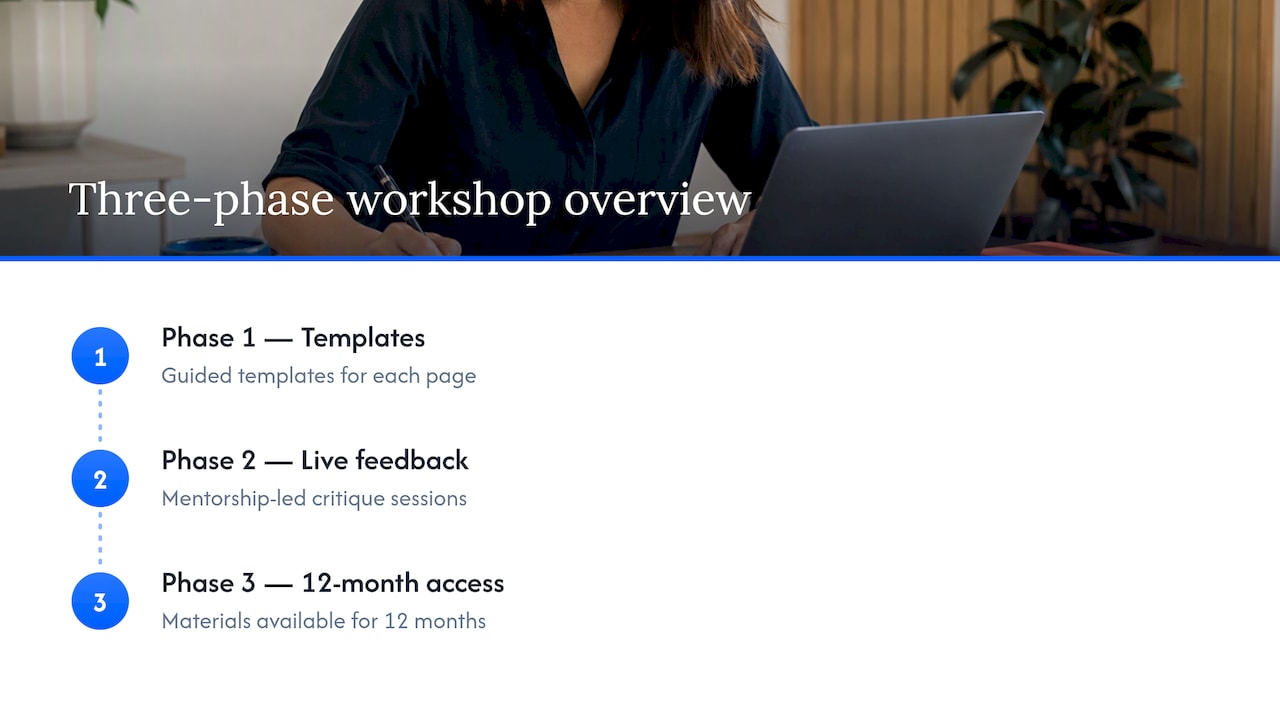
Reading examples gets you started. Turning them into a full set of pages that actually convert, with consistent messaging, proper CTAs, and copy that matches what customers search for, is a different job, and it’s the one MYB Workshops is built around. 
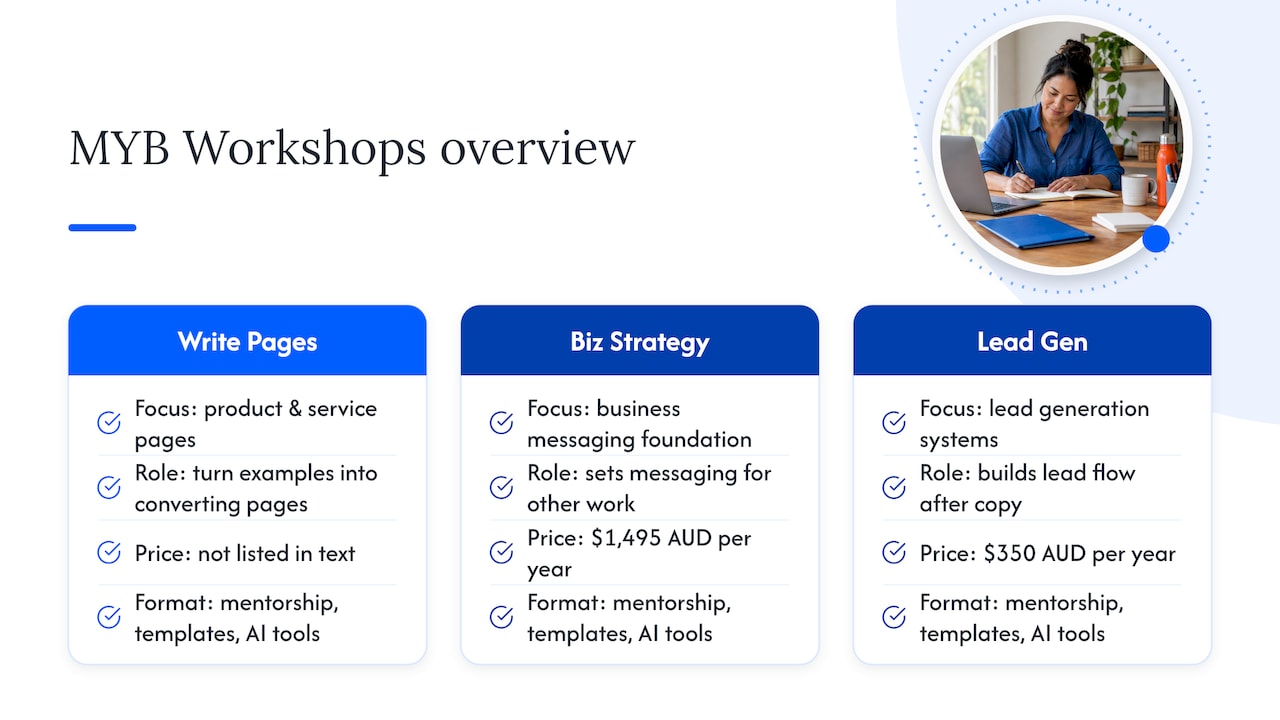
The programme blends personal mentorship with practical templates and AI tools, so you’re not staring at a blank page wondering where to start. The Write Winning Product & Service Pages Workshop focuses specifically on this task, while the #1 Business Strategy Workshop ($1,495 AUD per year) sets the messaging foundation everything else sits on. If lead flow is also a gap, the #7 Lead Generation System Workshop ($350 AUD per year) picks up where the copy leaves off. You can browse the full workshop lineup and find the one that matches where your business is right now.
This article draws on Business Victoria’s guidance on concise website copy, ACCC rules on truthful advertising and testimonials, University of Melbourne accessibility research on heading navigation, and Content Marketing Institute guidance on buyer-intent copy.
A strong service description leads with the customer’s problem and the outcome they want, followed by a short explanation of your approach and one clear call to action. Keep paragraphs short and use a heading that describes what the section actually covers.
There’s no fixed word count, but most effective service pages keep each section scannable, typically a headline, one outcome line, and two or three sentences of body copy. Shorter, well-structured sections tend to hold attention better than long blocks of text.
Yes, as long as they’re genuine, dated, and you have the customer’s consent on file. Under Australian Consumer Law, fabricated or unverifiable testimonials can attract penalties, so keep your evidence documented before you publish.
Use descriptive H2 and H3 headings instead of vague labels, since many screen reader users navigate primarily by headings. Pair that with short paragraphs and clear alt text on any images.
MYB Workshops runs a dedicated Write Winning Product & Service Pages Workshop that walks service business owners through writing and testing their own pages with mentorship and templates. It’s a practical option if you’d rather have guided support than work through examples alone.