

Content pillars are the three to five core themes that organise everything you post, so every piece of content ties back to a clear business goal instead of being a random idea plucked from thin air. For most service businesses, three to five pillars is the sweet spot: enough variety to keep your feed interesting, few enough to actually maintain. Each pillar should map to a goal, whether that’s building awareness, earning trust or generating enquiries.
TL;DR:
- Posting consistently across three to five core content pillars ensures balanced reach, trust, and leads within a sustainable content schedule suited to team capacity.
- Auditing past content, analyzing common questions, and mapping themes to customer journey stages help identify the most effective pillars tailored to your audience’s needs.
- Using repurposing strategies like cutting webinars into short videos or transforming testimonials into graphics enhances content efficiency and variety.
- Tracking specific metrics such as reach, saves, click-throughs, and enquiries provides meaningful insights into each pillar’s performance rather than relying on vanity numbers.
- Limiting to three to five pillars prevents fatigue, with clear ownership and regular review essential to maintaining relevance and achieving business goals.
The fastest way to understand pillars is to see them in action. Below are proven pillar themes service businesses use, along with post ideas and formats for each one.
For service businesses specifically, pairing an authority pillar with a proof pillar tends to work best. Helpful how-to content builds credibility, but it’s the case studies and testimonials sitting alongside it that reduce the hesitation a potential client feels before enquiring. Connection content rounds this out by making the business feel human rather than transactional, which matters more for services than for product sales because people are essentially hiring a person or a team, not just buying an item.
Short-form video deserves a special mention here. Globally, 87.5% of adults watch short-form video weekly, which makes it one of the most reliable formats for authority and edutainment pillars, particularly when a longer explanation can be trimmed into a 30 to 60 second clip (according to Digital 2025 global statshot data).
Picking pillars isn’t about guessing what sounds good. It’s a short, structured exercise that takes an afternoon, not a week.
This process connects directly to why content marketing attracts clients in the first place: pillars only work when they’re built around what your actual audience is asking, not what you assume they want to see.
Pro Tip: If you’re stuck for themes, read through your last 20 client enquiry emails. The questions that repeat are your pillars in disguise.
Once your pillars are set, the next job is turning them into a repeatable calendar. Two simple structures cover most service businesses.
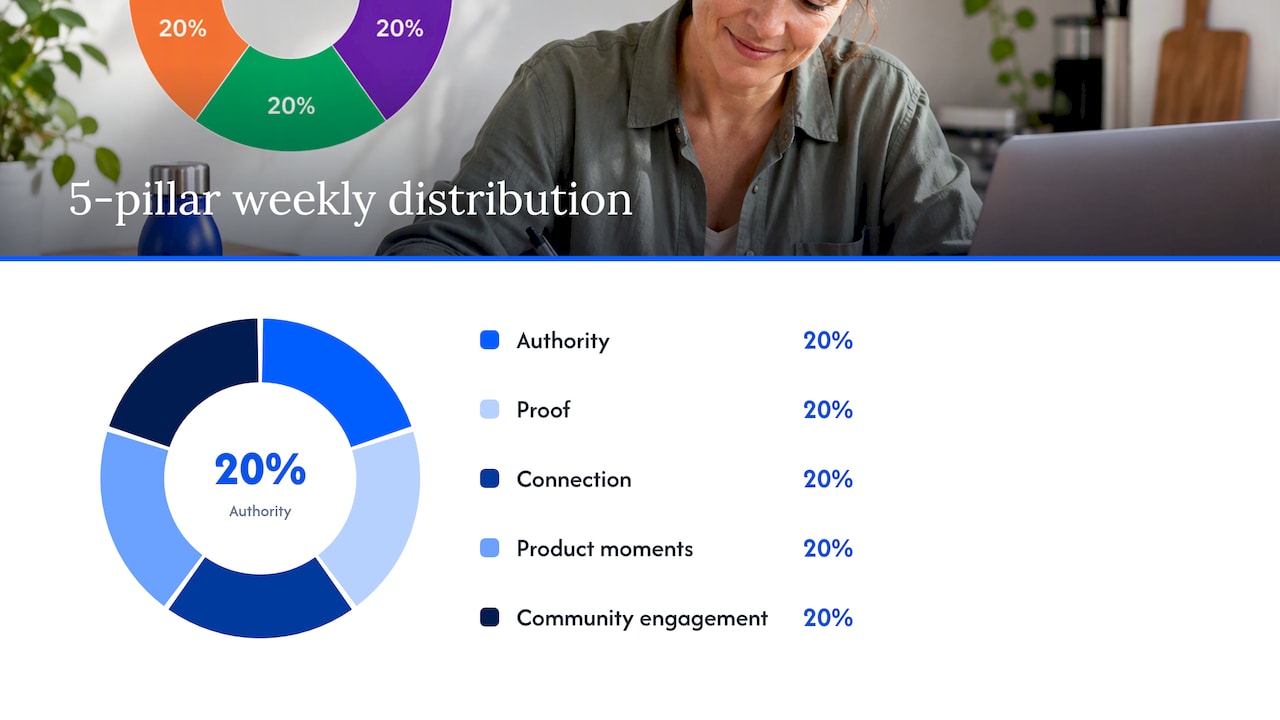
A 3-pillar monthly template works well for solo operators or small teams: one week each dedicated to authority, proof and connection content, with the fourth week reserved for a seasonal or promotional push. A 5-pillar weekly template suits businesses posting daily: rotate authority, proof, connection, product moments and community engagement across five posting days, repeating the cycle weekly.
Repurposing is what makes either template sustainable. A practical rule is one long asset becomes three short assets: a blog post, podcast episode or webinar can be cut into a short video, a carousel and a quote graphic, each slotted into a different pillar (Sprout Social’s guide to repurposing outlines a similar approach). Our own guide on repurposing content walks through six ways to stretch a single idea further.
| Pillar | Primary format | Platform pairing | Caption angle |
|---|---|---|---|
| Authority | Carousel or short video | Instagram, LinkedIn | “Here’s how we approach…” |
| Proof | Quote graphic or case study | Instagram, Facebook | “Here’s what changed for…” |
| Connection | Behind-the-scenes video | Instagram Stories, TikTok | “A day in the life of…” |
| Product moments | Short video walkthrough | Instagram, website | “Here’s exactly what’s included…” |
Cadence should match your team’s real capacity, not an ideal posting schedule you found online. A realistic starting point is three to five feed posts a week, with Stories posted more frequently since they take less production time.
If you’re a solo operator, batch-record connection and authority content on one day each month, then schedule proof and product content around client wins as they happen. For small teams, assigning one person as the “pillar owner” for authority and another for proof keeps quality consistent without everyone trying to do everything.
Vanity metrics like follower count tell you very little about whether a pillar is working. Match each pillar to a metric that reflects its actual job.
DataReportal’s Digital 2025 Australia report recommends testing new content approaches over a four to eight week window against a historical baseline rather than judging performance after a handful of posts, which gives genuinely useful platform and engagement benchmarks to compare against.
Beyond the numbers, pay attention to qualitative signals too: are the DMs and enquiries you’re getting actually relevant to what you offer, or are they off-target? A spike in reach with no increase in enquiry quality usually means the pillar is attracting attention without attracting the right audience.
The most common failure point is pillar fatigue: trying to maintain eight or ten themes until quality drops across all of them. Industry commentary consistently points to three to five pillars as the workable range, since it allows enough depth per theme without spreading a small team too thin (per research on Australia’s digital advertising and influencer economy).
Pro Tip: If a pillar hasn’t produced a saved post, a share or an enquiry in six weeks, it’s not working. Retire it rather than forcing it.
Choosing pillars is only half the job. The other half is building a system that actually gets content made and published week after week, which is where a structured, phased approach earns its keep over an ad hoc one.
A workable sequence looks like this: first, clarify your core messages so every pillar reflects what you actually want to be known for, rather than what feels easiest to post about. Second, choose your three to five pillars and build simple templates for each, so no one is starting from a blank page every week. Third, build the actual calendar, assign owners, and set a review point four to eight weeks out to check what’s working against the goals set in step one.
This mirrors the structure covered in our guide to why content pillars matter, which breaks down how pillars fit into a wider, sustainable marketing system rather than sitting as a one-off exercise.
These three terms get used interchangeably, which causes confusion for a lot of business owners trying to plan a calendar. A content pillar is a broad, ongoing category, such as “authority” or “proof”, that repeats indefinitely and anchors your overall content strategy. A content cluster is a group of related pieces built around one specific topic, often used in SEO to support a single core page with several supporting articles or posts linking back to it.
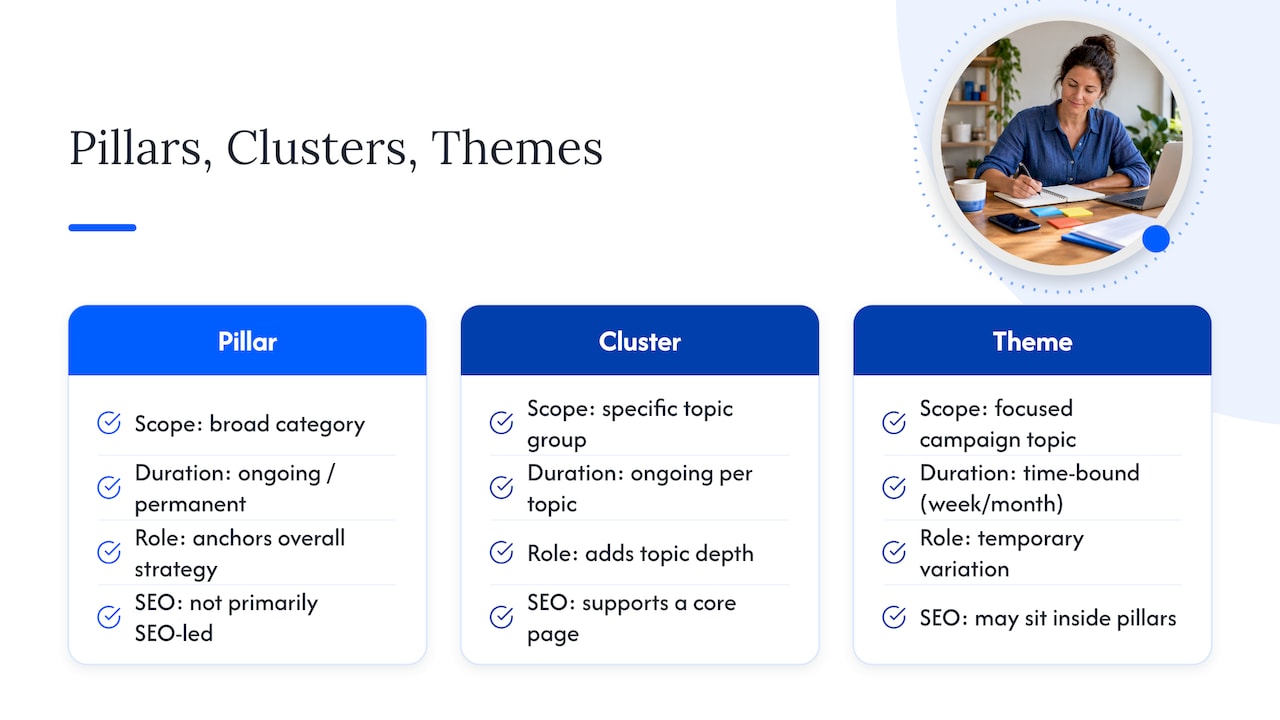
A content theme sits somewhere in between: it’s usually a time-bound focus, such as a month dedicated to “client wins” or a week themed around a seasonal event, that temporarily sits inside one or more of your existing pillars. Pillars are the permanent structure, clusters are the topic depth strategy usually tied to search and website content, and themes are short-term variations layered on top of pillars to keep things fresh. Understanding the difference matters because conflating them leads businesses to either over-plan (treating every post like it needs its own cluster) or under-plan (treating a one-off theme as if it should replace a pillar entirely).
While the pillar framework stays consistent, the specific themes shift depending on the industry. A wellness or beauty service business might build its plan around product moments, lifestyle integration and seasonal campaigns, as shown in one Australian brand’s approach to building a consistent monthly plan around those three themes (case example from Nio Design).
A trades or home services business tends to lean harder on proof (before-and-after job photos) and authority (maintenance tips), since trust in competence is the main barrier to booking. A professional services business, such as an accounting or legal practice, often prioritises authority and edutainment, breaking down complex topics into plain language to demystify the service. A hospitality or events business usually leans on connection and user-generated content, since atmosphere and experience are harder to convey through a how-to post.
The common thread across every industry is that the pillars should reflect what actually moves a potential client from curious to booked, not what looks impressive on a content calendar.
Picking pillars with confidence means grounding decisions in what your audience actually does online, not guesswork. More than 58% of people now turn to social media for brand and product research, which makes it worth checking what’s already working for your type of business before you commit to a pillar set (We Are Social’s Digital 2025 Australia report).
A few practical starting points: review your own Instagram or Facebook insights for the posts that already perform best, scan comment sections and DMs for recurring questions, and check what formats are trending in your industry through platform explore pages. The IAB Australia consumer trends report is also a useful reference for understanding which content formats and subcategories are growing, which helps when deciding where to invest production time. For ongoing measurement once pillars are live, a dedicated social media analytics tool can help track which pillar is actually converting attention into enquiries, rather than relying on gut feel alone.
Knowing your pillars is one thing, building a calendar that actually runs week after week is another. That’s where a structured workshop beats another afternoon of scrolling for inspiration: we walk you through clarifying your core message first, so every pillar you choose actually reflects what you want to be known for.

Three of our workshops speak directly to what this article covers. The Clarify Your Messages & Attract the Right Clients Workshop helps you nail down the messaging your pillars should be built around before you plan a single post. The Build a Stand-Out Brand Identity & Guidelines Workshop gives your content a consistent look and feel across every pillar. The Lead Generation System Workshop helps turn your proof and product pillars into an actual enquiry pipeline rather than content that sits there looking nice.
If you want the full framework rather than piecing it together yourself, our Business Strategy Workshop is the place to start, with 12 months of access.
There’s no single fixed set of five pillars that applies to every business. Most service businesses do best choosing three to five themes from options like authority, proof, connection, product moments and community engagement, matched to their own goals and audience.
Yes: a how-to carousel, a client case study, a behind-the-scenes video, a founder story, a product walkthrough, a seasonal tip post, a reposted client photo, a trend-based Reel, a myth-busting carousel and a community poll. Each ties back to one of the core pillar themes covered above.
Start by auditing your existing content and the questions clients repeatedly ask, then map those recurring themes to the stages of your customer journey. Narrow the list to three to five pillars, each tied to a clear goal such as awareness, trust or enquiries, and validate the choice with a four to eight week test.
A content pillar isn’t a single format, it’s a theme that can be expressed through multiple formats such as short video, carousels, long-form posts or testimonials. The right format depends on the pillar’s goal: authority often suits how-to carousels or short video, while proof often works best as a case study or testimonial quote graphic.