

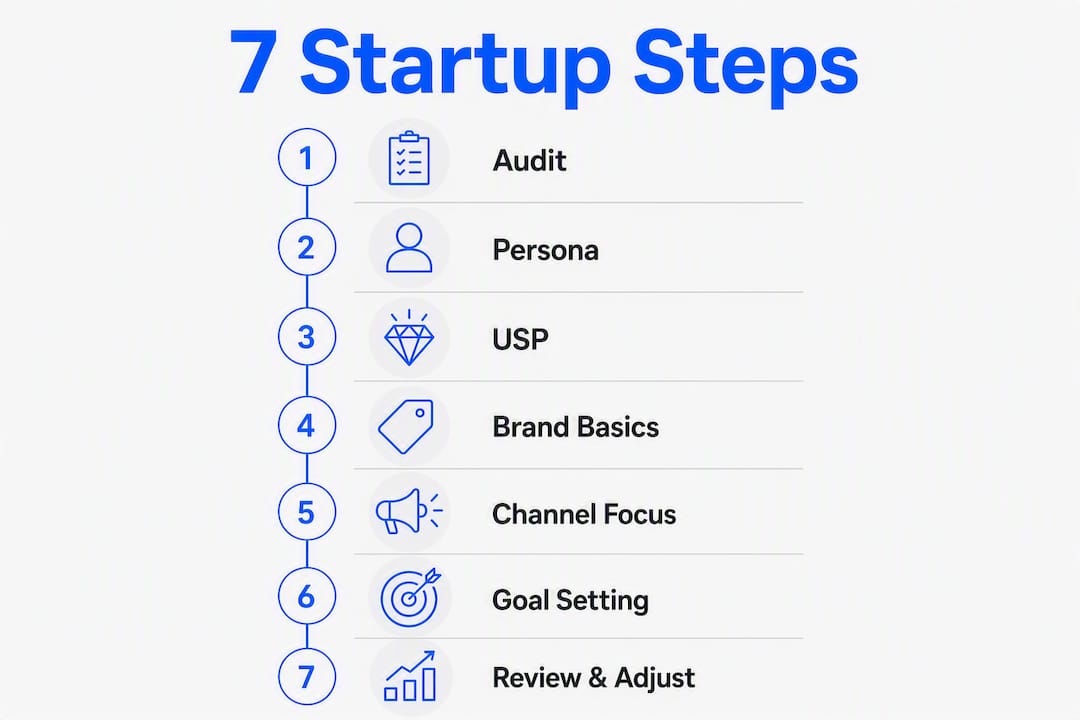
The minimum viable marketing foundation for a startup is seven clear steps you can set up in 90 days. That is the verdict from business.gov.au, the SBDC’s eight-step marketing process, and the practical experience of founders who have built service businesses from scratch in Australia. The steps are: run a fast market audit, define one core persona, craft your USP and positioning, set your brand basics, pick 1–3 channels, set SMART goals and a budget, then write a one-page plan with a 90-day execution roadmap.
These are not abstract concepts. They are the set marketing foundation startup steps that separate founders who get traction in their first quarter from those who spend six months posting on every platform and wondering why nothing is working.
Your 90-day quick-start checklist:
On budget: Reckon’s small business marketing handbook recommends treating marketing spend as a percentage of revenue, with a typical percentage for most small businesses, which rises during active growth phases.
Good marketing starts with knowing what you are walking into. A fast market audit in week 0–1 does not need to be a 40-page report. It needs to answer three questions: Is there real demand? Who is already serving it? Where is the gap?
Australian government guidance recommends beginning with a situation audit that covers your current strengths, market gaps and obvious threats before setting any goals. The ANZ small business marketing guide reinforces this: start marketing planning alongside your business plan, using a SWOT to inform your target market, competitor analysis and key messages.
Run your week-one audit in this order:
Free and low-cost tools available in Australia:
Pro Tip: When running customer interviews, open with “Tell me about the last time you tried to solve [problem]” rather than “Would you use a product like this?” The first question surfaces real behaviour; the second invites polite agreement that tells you nothing useful.
Most early-stage founders make the same mistake: they describe their target customer as “anyone who needs this.” That approach spreads effort thin and produces messaging that resonates with nobody. One well-defined persona, built from your week-one research, gives every piece of content and every sales conversation a clear direction.

A persona is not a demographic box. It captures what your customer is trying to achieve (their job-to-be-done), what triggers them to look for a solution, which channels they use to find it and what objections they raise before buying.
Core persona template:
Example persona for an Australian service startup:
Sarah, 38, runs a small accounting practice in Brisbane. She wants to attract more professional services clients without relying on referrals alone. Her buying trigger is a slow quarter. She searches Google and asks peers on LinkedIn. Her top objection is “I don’t have time to learn marketing.” She decides based on clear process, proof of results and a realistic time commitment.
Once you have your persona written, use a simple prioritisation matrix to confirm you are targeting the right segment first. Plot customer segments on two axes: reach (how many people match this profile in your market) versus value (how much revenue each customer represents). Start with the segment that sits in the high-reach, high-value quadrant.
A USP (unique selling proposition) is the single clearest reason a customer should choose you over every other option. Most early-stage founders write something vague like “we deliver quality service with a personal touch.” That is not a USP. It is a placeholder.
A useful positioning template has three parts: who you help + the core benefit they get + what makes it different or credible. Put it in one sentence.
Three example headlines you can adapt:
Notice that each example names a specific audience, a specific outcome and a specific mechanism or proof point. That specificity is what makes a USP credible rather than generic.
Testing your USP quickly:
Pro Tip: The fastest way to test a USP is to send 20 personalised LinkedIn messages using version A and 20 using version B. Compare reply rates after one week. You will have real data before you spend a cent on ads.
Brand identity does not mean spending $5,000 on a logo before you have a single customer. It means having enough consistency that when someone visits your website or receives your email, they immediately understand what you do and why it matters to them. ANZ’s guidance makes the point plainly: a brand is more than a logo; positioning that emotionally connects with your target customer is the anchor for every piece of content and every sales conversation.
Brand basics checklist:
Website essentials:
Dos and don’ts for early brand work:
Australian marketing law requires that all advertising claims be truthful and not misleading under ACCC guidelines, and that any email marketing comply with the Spam Act 2003, including a clear unsubscribe option and your business contact details in every email.
Picking the right channels is one of the highest-leverage decisions you make early on. The wrong choice wastes three months of effort. The right choice compounds. Reckon’s small business marketing handbook notes that product businesses often lean toward Instagram, Facebook and TikTok, while B2B businesses typically get better results from LinkedIn and search.

The rule is simple: do 1–3 channels consistently for 90 days before adding more.
| Channel | Best for | Time to meaningful results | Approx. early-stage cost | Core KPI |
|---|---|---|---|---|
| Organic search (SEO + Google Business Profile) | Local services, B2B and B2C | 3–6 months | Low ($0–$200/month) | Organic sessions, ranking position |
| Paid search (Google Ads) | B2B and B2C with clear search demand | 4–8 weeks | Medium ($1,500–$3,000/month test budget) | Cost per lead, conversion rate |
| LinkedIn (organic + outreach) | B2B services, professional audiences | 6–12 weeks | Low (time only) | Connection acceptance rate, reply rate |
| Instagram / TikTok | B2C, visual products, lifestyle services | 8–12 weeks | Low to medium | Reach, saves, DM enquiries |
| Email nurture | All business types, existing contacts | 2–4 weeks | Low ($0–$50/month) | Open rate, click rate, replies |
| Partnerships and referrals | Service businesses with complementary providers | 4–8 weeks | Low (time only) | Referral volume, conversion rate |
Minimum viable setup per channel:
Being everywhere sounds productive. It is not. A founder who posts sporadically across six channels produces less measurable traction than one who shows up consistently on two.
Goals without numbers are wishes. SMART goals (Specific, Measurable, Achievable, Relevant, Time-bound) give you a clear signal when something is working and a clear reason to stop when it is not.
SMART goal examples for a service startup:
KPI tracking table:
| Metric | Track weekly | Track monthly | What it signals |
|---|---|---|---|
| Website sessions | Yes | Yes | Channel reach and content performance |
| Lead volume (enquiries, form fills) | Yes | Yes | Whether traffic is converting |
| Conversion rate (leads / sessions) | No | Yes | Quality of messaging and offer |
| Customer acquisition cost (CAC) | No | Yes | Efficiency of paid spend |
| Email open rate | Yes | Yes | Relevance of subject lines and list quality |
| Referral source breakdown | No | Yes | Which channels are actually driving leads |
Early-stage budget guidance for Australian startups:
Reckon recommends treating marketing as a percentage of revenue: a typical proportion for most small businesses, increasing during active growth phases. For paid channels, a dedicated test budget gives you enough data to make decisions without overcommitting.
Budget reallocation rules:
A one-page marketing plan forces clarity. If you cannot fit your strategy on one page, you do not have a strategy yet — you have a list of ideas. The SBDC’s eight-step marketing process and the seven-step marketing management cycle both reinforce the same structure: research, objectives, strategy, resources, execution, measurement, review.
One-page marketing plan template:
90-day execution roadmap:
| Week | Focus | Key tasks | Owner |
|---|---|---|---|
| 1 | Audit | SWOT, 10 customer interviews, keyword scan, competitor review | Founder |
| 2 | Persona + USP | Write core persona, draft USP, test two headline versions | Founder |
| 3 | Brand basics | Finalise logo, colours, key messages, website headline | Founder / designer |
| 4 | Channel setup | Build minimum viable assets on 1–3 channels | Founder / contractor |
| 5–6 | Content launch | Publish first content pieces, send welcome email sequence | Founder |
| 7–8 | Paid test (if budget) | Launch one small paid campaign, track cost per lead | Founder |
| 9–10 | Review + iterate | Analyse KPIs, cut underperforming tactics, double down on wins | Founder |
| 11 | Scale what works | Increase output on best-performing channel, plan month four | Founder |
Short copy snippets you can use now:
Your first 20 customers are your most valuable marketing asset. They can tell you exactly why they bought, what almost stopped them and what they would tell a friend. That information shapes every piece of content you produce for the next 12 months.
Three-email nurture sequence for new customers:
Feedback question script for interviews or surveys:
Low-cost referral ideas:
Running a short onboarding call (15–20 minutes) within the first week of a new customer’s experience increases retention and gives you the testimonial material you need. Ask for permission to quote them before the call ends.
Most founders set up tracking once and never look at it again. The ones who grow consistently treat measurement as a weekly habit, not a quarterly report. A simple review cadence keeps you honest about what is working and gives you the data to make confident decisions.
Review cadence:
Four core metrics every startup should watch:
Decision rules:
The consensus from business.gov.au, the SBDC and ANZ is consistent: audit your situation, define your target customer, establish your positioning, choose your channels, set measurable goals, and review regularly. That is the core cycle. Everything else is elaboration.
The minimum viable marketing strategy guidance from ROI.com.au adds an important nuance for startups specifically: the approach is about focused experimentation. Deep customer discovery first, then content-led search strategy, a targeted social presence and email list building from day one. Analytics-driven iteration follows. You are not trying to get everything right in week one. You are trying to learn fast enough to get it right by week twelve.
Two practical Australian examples:
Both examples follow the same principle: pick 1–3 channels, build the minimum viable presence, show up consistently and measure what happens.
Early marketing strategy matters most in the first 90 days because the habits and systems you build then become the foundation you scale from. Mybworkshops workshops and templates are built around exactly this framework, from brand messages and one-page plans through to 90-day roadmaps and lead generation systems.
Building a strong marketing foundation comes down to seven steps: audit, persona, USP, brand basics, channel selection, SMART goals and a one-page plan with a 90-day execution roadmap.
| Point | Details |
|---|---|
| Start with a fast audit | Run a SWOT, 10 customer interviews and a keyword scan in week one before spending anything. |
| One persona, one USP | Write one core persona and a single-sentence USP before building any assets or choosing channels. |
| Pick 1–3 channels only | Do fewer channels consistently for 90 days; spreading across six produces less traction than mastering two. |
| Budget as a revenue percentage | Allocate 3–5% of revenue to marketing typically, rising to 8–12% during active growth phases. For paid channels, a dedicated test budget of $1,500–$3,000 per month is recommended. |
| Mybworkshops workshops | Mybworkshops provides practical templates, one-page plans and 90-day roadmaps that map directly to these seven steps. |
Knowing the seven steps is one thing. Having the templates, the worked examples and someone to check your thinking is what closes the gap between a plan on paper and a marketing engine that actually brings in clients.
Mybworkshops workshops are built specifically for service-based business owners who want to do their own marketing properly, without wasting months on tactics that do not fit their business. The Build A Better Business program covers brand positioning, website conversion, lead generation and organic visibility in a structured sequence, with practical templates you can use the same week. Each workshop is hands-on: you leave with a completed asset, not just notes.
Real client results documented on the Mybworkshops site show measurable improvements in conversion rates and reduced wasted ad spend for service businesses that follow the structured approach. The community model means you are not working through it alone.
If you are at the start of this process, the current workshops are the fastest way to move from “I know I need a marketing plan” to “I have one, and it is working.” Browse the available workshops and pick the one that matches where you are right now.
These resources plug directly into the seven-step process and are free or low-cost to access.
The seven steps are: audit your current situation (SWOT), set SMART objectives, define your target customer, conduct competitive analysis, establish your positioning and USP, choose priority channels and allocate budget, then execute and review regularly. This cycle is consistent across business.gov.au guidance and standard marketing management frameworks.
In a startup marketing context, the 80/20 principle suggests that roughly 80% of your leads or revenue will come from 20% of your channels or tactics. Focus your first 90 days on identifying that 20% through consistent testing and measurement rather than spreading effort evenly across every possible channel.
The 3-3-3 rule is not a single standardised framework; definitions vary across sources. A common version used in startup marketing describes it as: reach the right person, with the right message, at the right time. In practice, this maps to knowing your persona, having a clear USP and choosing channels where your target customer is already active.
Organic channels like SEO typically take 3–6 months to produce consistent results, while paid search and email nurture can show meaningful data within 4–8 weeks. Setting a 90-day review point gives you enough data to make confident decisions about which channels to scale and which to stop.
Reckon’s guidance suggests 3–5% of revenue as a typical starting point for small businesses, rising to 8–12% during active growth phases. For paid channel testing, a dedicated monthly budget of $1,500–$3,000 gives you enough data to evaluate performance.