

SEO is defined as the practice of making your website visible to people who are actively searching for what you sell. For service-based businesses, the role of SEO in lead generation goes well beyond rankings. It connects you with buyers at the exact moment they are looking for a solution, which is why SEO-driven leads close at 14.6% compared to just 1.7% for outbound marketing. That is not a marginal difference. It means SEO-generated leads are nearly nine times more likely to convert into paying clients. If your website is not working as a lead generation engine, you are leaving a significant and predictable source of revenue untouched.
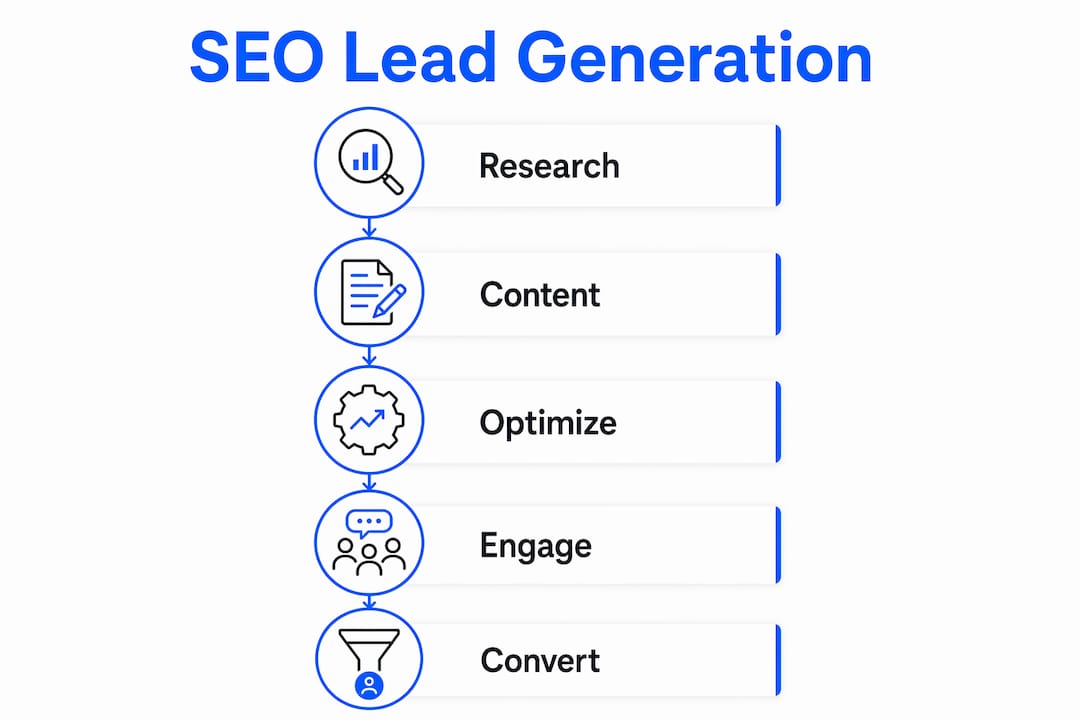
The most important concept in SEO for lead generation is search intent. Every search query signals where a buyer sits in their decision process. Someone typing “what is a brand strategy” is researching. Someone typing “brand strategy workshop Sydney” is ready to buy. These two searches require completely different content responses.
High search volume keywords often generate low revenue compared to niche keywords with strong buying intent. This surprises most business owners who assume more traffic equals more leads. The reality is that a page ranking for a specific, high-intent phrase will consistently outperform a page chasing broad traffic with no commercial signal.
Buyer intent falls into two main categories:
Content tailored to funnel stages with matching calls-to-action and internal links transforms organic traffic into measurable leads. A blog post answering a common question should link naturally to your service page. That path from curiosity to enquiry is the foundation of a working SEO lead generation strategy.
Pro Tip: Start your keyword research by listing the questions your best clients asked before they hired you. These are your highest-value content opportunities.
Most service businesses treat SEO and sales as separate activities. This separation costs them leads. When your sales process and your content strategy share the same intelligence, your website starts answering the exact questions that close deals.
The most practical way to do this is to mine your sales conversations for objections. Every time a prospect says “how does this compare to doing it myself?” or “what does this actually cost?” they are giving you a content brief. Integrating tagged sales objections into SEO content briefs creates a feedback loop that improves both content relevance and future lead qualification.
Here is a practical process for aligning your SEO content with your sales team’s insights:
Separate KPIs for SEO and sales create revenue leakage. When both functions share a dashboard and a common goal, lead quality improves and sales cycles shorten. For a service business, this alignment is often the difference between a website that generates enquiries and one that simply exists.
Pro Tip: Ask your best clients what they searched for before they found you. Their exact phrases are often your most valuable keywords.
Technical SEO is the architecture underneath your content. It determines whether your pages get found, whether visitors stay, and whether they take the next step. For lead generation, three technical areas matter most: internal linking, conversion architecture, and page experience.

Structured internal linking between blog content and service pages produced a 145% increase in goal completions over 18 months and compressed sales cycles by 18–25%. That result comes from a deliberate strategy: every blog post links to a relevant service page, and every service page links to supporting content that builds confidence. The path from awareness to enquiry becomes shorter and clearer.
Conversion architecture refers to how your calls-to-action, page layouts, and contact forms are structured. A common mistake is using the same call-to-action on every page regardless of where the visitor is in their decision process. A visitor reading an introductory blog post is not ready to book a call. Offering them a free resource or a short guide is a better match for their intent. A visitor on your pricing page is much closer to a decision and needs a direct, low-friction next step.
| Technical element | Lead generation impact |
|---|---|
| Internal linking from blog to service pages | Increases goal completions and reduces bounce rates |
| Intent-matched calls-to-action | Improves conversion rates at each funnel stage |
| Fast page load times | Reduces abandonment before the visitor reads your offer |
| Mobile-optimised layouts | Captures leads from mobile search, which dominates service queries |
| Structured data markup | Improves visibility in AI-generated search results |
Optimising content for Generative Engine Optimisation (GEO) with clear structures and definitive answers improves visibility in AI-powered search results. In 2026, AI models surface content that answers specific buyer questions directly. Bullet points, clear headings, and concise summaries are not just good writing practice. They are a technical requirement for appearing in AI-driven discovery.
Reviewing your website conversion killers is a practical starting point. Small fixes to page structure and calls-to-action often produce immediate improvements in lead volume without requiring new content.
Traffic and rankings are not revenue. They are signals, and they can mislead you. A page ranking number one for a broad keyword might generate thousands of visits and zero enquiries. A page ranking fifth for a specific, high-intent phrase might generate your best clients every month.
Measuring SEO success by financial metrics like organic-sourced revenue and cost per organic acquisition outperforms traditional traffic and ranking metrics. Reporting financial outcomes shifts your content investment toward pages that actually drive revenue.
The table below contrasts the two measurement approaches:
| Vanity metrics | Revenue metrics |
|---|---|
| Total organic traffic | Organic-sourced leads and enquiries |
| Keyword rankings | Pipeline value from organic search |
| Page impressions | Cost per organic acquisition |
| Bounce rate | Lead-to-client conversion rate by page |
Organic close rates for sales-qualified leads are 22% versus 13% for paid social, and the median organic customer acquisition cost is $1,840 compared to $4,720 for paid search. These figures make the financial case for SEO clearly. Organic leads cost less to acquire and convert at a higher rate.
SEO should be treated as an end-to-end revenue discipline, integrating sales, marketing, and product insights for predictable pipeline growth. When you measure it that way, you make better decisions about where to invest your content effort and your time.
Building SEO as a lead generation engine does not require a large budget or a technical team. It requires a clear process and consistent execution. Start with what you already have.
Planning your SEO strategy with your business goals in mind from the start prevents the common mistake of creating content that attracts the wrong audience. Every piece of content should have a clear purpose tied to a specific type of lead you want to attract.
The importance of SEO in sales grows over time because organic content compounds. A well-written service page or blog post continues to attract leads months and years after it is published, unlike paid advertising which stops the moment you stop spending.
Mybworkshops runs expert-led workshops built specifically for service-based business owners who want a marketing system that actually generates leads. The focus is on practical strategy, not theory.
The Lead Generation System Workshop walks you through building a sales funnel that integrates SEO, content, and conversion strategy into one connected system. You will leave with a clear plan, not just ideas. If you want to see the full range of workshops available, the Mybworkshops programme covers everything from business strategy to SEO mastery, all designed for service businesses ready to grow with intention.
SEO drives qualified leads by connecting your service business with buyers who are actively searching for what you offer, producing close rates far higher than outbound marketing.
| Point | Details |
|---|---|
| Intent beats traffic volume | Target high-intent keywords like pricing and comparison queries, not broad terms with low commercial value. |
| Sales and SEO must share data | Use CRM objections to brief content and align KPIs so both functions drive the same revenue goal. |
| Internal linking accelerates results | Linking blog posts to service pages increases goal completions and shortens the path to enquiry. |
| Measure revenue, not rankings | Track organic-sourced leads, cost per acquisition, and pipeline value to make better content decisions. |
| Audit before you create | Review existing pages for conversion gaps before producing new content to avoid wasted effort. |
SEO attracts buyers who are actively searching for your service and connects them to your website at the moment of highest intent. Because these visitors are already looking for a solution, they convert into leads at significantly higher rates than cold outbound contacts.
Organic leads cost less to acquire and close at higher rates than leads from paid channels. The median organic customer acquisition cost is $1,840 compared to $4,720 for paid search, making SEO a more cost-effective long-term lead source.
SEO typically takes three to six months to produce consistent lead flow, depending on your market, content quality, and website authority. High-intent pages targeting specific service queries often show results faster than broad informational content.
Bottom-of-funnel content addressing pricing, comparisons, and specific outcomes generates the most qualified leads. These pages attract buyers who are close to a decision and need a clear reason to contact you.
Yes. Fast load times, mobile-optimised layouts, structured internal linking, and clear calls-to-action all directly affect whether a visitor becomes a lead. Technical SEO is the foundation that makes your content work harder.