

A marketing engine is a repeatable, always-on system that connects your strategy, messaging, channels, and measurement into one continuous process that generates predictable leads and revenue. Unlike a one-off campaign, it compounds over time, making each month’s marketing more effective than the last.
Quick self-assessment — do you already have one?
If you answered “no” to three or more of these, you have campaigns, not an engine. The good news is that building one is a staged process, not a single project.
Core engine elements at a glance:
Tools like HubSpot, Zoho CRM, or even a well-configured Mailchimp account can anchor the tech side. Google Analytics 4 (GA4) handles measurement. Mybworkshops provides the strategic framework and guided build process for service-based business owners who want to put it all together without guessing.
A functioning system has eight components. Each one owns a specific job, and together they form a conversion path from stranger to paying client.
| Stage | What happens | Component that owns it |
|---|---|---|
| Awareness | Prospect finds you via SEO, ads, or referral | Channels |
| Capture | They download a lead magnet or book a call | Website / landing page |
| Nurture | Automated email sequence builds trust | CRM / activation workflow |
| Qualification | Lead meets your ICP criteria | ICP definition + CRM rules |
| Sale | Proposal sent, contract signed | Sales handoff process |


For most small service businesses, the right stack is simple: one CRM (Zoho CRM and HubSpot both have free or low-cost tiers available in Australia), one email platform (Mailchimp or ActiveCampaign), and GA4 for analytics. The selection criteria that matter are ease of use, local support, and whether the tool can grow with you. A $50/month stack you actually use beats a $500/month platform you do not. For a full breakdown of DIY marketing tools for small businesses, Mybworkshops has a dedicated guide.
Reviews, content, and SEO add value month over month when they are connected to this conversion infrastructure. That compounding effect is what separates a system from a series of tasks.
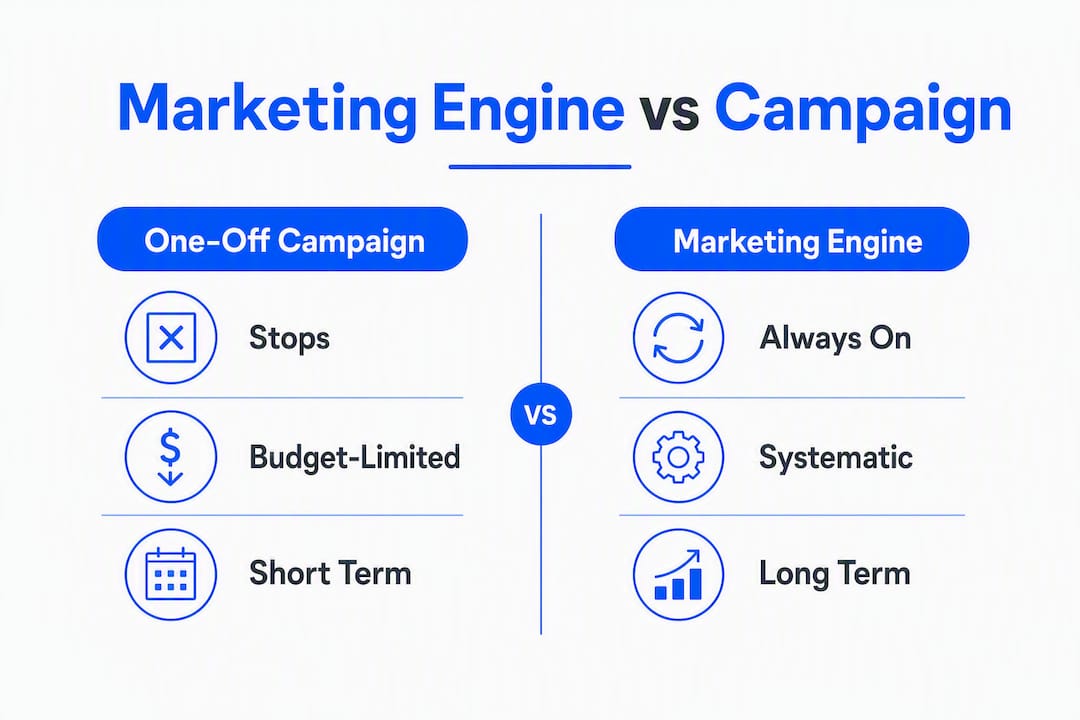
Most small businesses run marketing as a series of campaigns: a Google Ads push in March, a social media blitz before Christmas, an email to the list when things go quiet. Each one starts from scratch. There is no carry-over, no compounding, and no predictability.
A marketing engine makes campaigns supportive rather than primary. The system runs continuously, and campaigns plug into it for tactical spikes.
| Dimension | One-off campaign | Marketing engine |
|---|---|---|
| Continuity | Stops when budget runs out | Always on |
| Results over time | Resets each cycle | Compounds month over month |
| Documentation | Usually ad hoc | Processes and rules are written down |
| Sales handoff | Inconsistent | Defined and repeatable |
| Predictability | Low | High |
A practical example: A bookkeeper runs a Facebook Ads campaign in July for end-of-financial-year. It generates 40 leads. She follows up manually, converts six, and then the campaign ends. In August, lead volume drops to zero. She runs another campaign. The cycle repeats.
With an engine, those 40 leads enter a CRM, receive an automated nurture sequence, and are scored against her ICP. The ones who do not convert in July stay in the system and receive relevant content through August and September. Some convert three months later. Her SEO content, built during the same period, starts ranking and brings in organic leads that cost nothing per click.
Campaigns still have a role. A product launch, a seasonal promotion, or a new service offering all warrant a focused campaign. The difference is that the campaign feeds the engine rather than replacing it. Understanding how campaigns fit into a wider system makes the investment go further every time.
Pro Tip: Before you run your next campaign, check that your CRM is set up to capture every lead it generates. A campaign without a capture system is traffic without a destination.
The build follows four stages. Each one has a clear output, and the sequence matters. Skipping to activation before the foundation is solid compounds wasted spend, not results.
Before you build anything, audit what you have.
Diagnostic questions to find your biggest gap:
Pro Tip: The 4-step content marketing engine framework — strategy, idea sources, repeatable processes, roles — applies directly to this activation stage. Write it down before you launch.
A practical build checklist can help you stay on track through weeks 1–12 without losing momentum.
Measuring the right things at each stage stops you from optimising the wrong part of the system. Focusing on conversion and retention often delivers higher revenue impact than simply increasing top-of-funnel volume.
| Engine stage | KPI | What to aim for |
|---|---|---|
| Awareness | Monthly organic sessions, reach | Steady month-on-month growth |
| Capture | Lead conversion rate (visits to leads) | typical ranges vary for most service pages |
| Nurture | Email open rate, click-through rate | typical open rates and click-through rates vary widely |
| Conversion | Lead-to-client rate | varies depending on service type |
| Retention | Repeat purchase rate, referral rate | Referrals as a % of new clients |
A few principles that keep reporting useful rather than overwhelming:
Marketing that actually works comes from measuring the right things consistently, not from tracking everything.
Most engines stall not because of a lack of effort, but because of a handful of fixable problems.
Buying tech without rules. A CRM with no agreed workflow is just an expensive contact list. Before you set up any automation, write a short SOP: what triggers the action, who owns it, and what happens next. Technology is the grease, not the engine itself.
Pro Tip: Set up your CRM with three lead statuses before you add any automation: New, Nurturing, and Qualified. Simple rules prevent leads from falling through the cracks.
Unclear lead qualification. If you do not define what a qualified lead looks like, your sales conversations will be inconsistent and your conversion rate will be unpredictable. Write down the three criteria a lead must meet before you invest time in a proposal.
No measurement baseline. You cannot improve what you have not measured. Before you change anything, record your current lead volume, website conversion rate, and close rate. These three numbers are your starting point.
Inconsistent messaging. If your website says one thing, your social media says another, and your proposals say a third, prospects lose confidence. Every touchpoint should reflect the same positioning statement you wrote in the foundation stage.
Ignoring the handoff to sales. The marketing-to-sales handoff is often the single biggest lever for revenue. Define what “qualified” means, and set a clear response time for following up with a qualified lead. Without this rule, warm leads go cold.
Red flags that your engine is stalling:
The problem: A three-person accounting firm in regional New South Wales was generating most of its new clients through word-of-mouth. Referrals were inconsistent, and the team had no way to predict revenue three months out.
The engine they built: They defined their ICP (small business owners in their region with 1–5 staff), wrote a clear positioning statement, and built a simple lead magnet (a tax-time checklist) promoted via Google Search ads and a monthly email newsletter. Every enquiry entered Zoho CRM with a documented follow-up sequence.
The outcome: Within four months, organic search traffic to their website doubled. Lead volume became consistent enough to forecast. The team reduced time spent on manual follow-up by moving to automated email sequences, freeing up roughly half a day per week.
Lesson to copy: A single, well-targeted lead magnet paired with a simple CRM workflow can replace inconsistent referral dependency without a large budget.
The problem: A freelance copywriter based in Melbourne was fully booked some months and had no work in others. She had no system for generating leads during busy periods, so the feast-and-famine cycle continued.
The engine she built: She published two long-form SEO articles per month targeting the search terms her ideal clients used, added a free brief template as a lead magnet, and set up a simple ActiveCampaign sequence to nurture new subscribers. She tracked everything in GA4 and reviewed her numbers monthly.
The outcome: After six months, organic traffic was her primary lead source. The feast-and-famine cycle flattened because the content kept generating enquiries even when she was too busy to actively market. Her email list became a reliable source of repeat and referral work.
Lesson to copy: Consistent content connected to a capture asset and a nurture sequence is the lowest-cost engine available to a solopreneur. The compounding effect takes time, but it is durable.
Mybworkshops runs expert-led, online workshops specifically designed for service-based business owners who want a working engine, not just more marketing advice. The programme maps directly to the four-stage build process described in this guide.
Programme phases:
When to choose a workshop over DIY:
If you have prior marketing experience and time to experiment, the DIY path is viable. Mybworkshops’s free resources and digital templates are a practical starting point. For owners who want the fastest path to a functioning engine, the guided workshop programme removes the guesswork.
Pro Tip: The Build a Better Business workshop is the logical starting point if you are not sure which workshop to take first. It maps your current position to the engine components you need to build.
Ready to stop guessing and start building? Browse the full workshop programme and find the session that matches your biggest gap.
A marketing engine works because it connects strategy, messaging, channels, and measurement into one repeatable system that compounds over time rather than resetting with each campaign.
| Point | Details |
|---|---|
| Definition | A marketing engine is a repeatable, always-on system that generates predictable leads and revenue. |
| Foundation first | Fix website conversion and core messaging before increasing lead volume or ad spend. |
| Four build stages | Diagnose, build foundations, activate lead-generation tracks, then optimise with data. |
| Measure what matters | Track lead volume, conversion rate, and pipeline value weekly; review channel performance monthly. |
| Campaigns plug in | Campaigns are tactical spikes that feed the engine, not replacements for it. |
A short list of trusted resources to deepen your understanding and support your build:
A marketing engine is a connected system of strategy, messaging, channels, and measurement that generates leads and clients on a repeatable basis. Unlike a campaign, it runs continuously and gets more effective over time.
A common example is an SEO article that attracts organic traffic, a lead magnet that captures email addresses, an automated nurture sequence in a CRM, and a defined qualification process that flags ready-to-buy leads for follow-up. Each part feeds the next.
Start with a diagnosis of your current gaps, then build the foundation (positioning, website, CRM), activate one repeatable lead-generation track, and optimise based on weekly KPI reviews. A 90-day plan that sequences these stages is the most practical approach for small businesses.
A campaign is a time-limited push with a defined start and end. A marketing engine is always on, and campaigns plug into it for tactical spikes. The engine ensures that leads generated by a campaign are captured, nurtured, and followed up even after the campaign ends.
Lead conversion rate (visits to enquiries), lead-to-client rate, and monthly lead volume are the three numbers to watch weekly. Retention and referral rates become important once the acquisition side is stable.