

Partnerships are one of the fastest, lowest-risk ways for a service-based business to land warm leads and real revenue in its early growth phase. The role of partnerships in early growth comes down to three things: speed, credibility and shared cost. Instead of building an audience from scratch, you borrow trust that already exists.
Here’s what to do this week:
Groups like BNI and Business Chicks exist specifically to shortcut this process, and platforms like LinkedIn make it possible to find and vet a prospective partner in a single afternoon. None of this requires a big budget. It requires a clear offer and the willingness to ask.
Partnerships accelerate early growth because they hand you distribution, credibility and shared cost that would otherwise take years to build alone.
| Point | Details |
|---|---|
| Partnerships speed market entry | Borrowing a partner’s audience and trust cuts the time to warm leads compared with organic-only tactics. |
| Match the type to the goal | Referral partnerships suit quick lead flow; joint ventures suit co-created offers with shared risk. |
| Qualify before you pitch | Check audience overlap, trust signals and business health before reaching out. |
| Formalise the terms early | A written referral agreement with clear payment triggers prevents most disputes. |
| Track partner-level KPIs | Leads introduced, conversion rate and time-to-close reveal which partnerships are actually working. |
| Start with Mybworkshops templates | The workshops give you ready-made outreach scripts, agreements and tracking sheets to skip the guesswork. |
Identify one potential partner today and book a 30-minute call this week. Treat the first 90 days as a pilot, not a permanent commitment, and let the results decide what comes next.
Partnerships let you enter a market or launch a new offer in months, not years, because you’re borrowing someone else’s distribution, audience trust and infrastructure instead of building your own from the ground up. That’s the core finding behind Sprintlaw’s work on strategic partnerships: pooling resources, whether that’s shared marketing spend, technical tools or subject expertise, cuts both overhead and risk while extending your reach.
For a solo operator or small team, this matters more than almost any other early growth lever. You don’t have the marketing budget to buy attention, and you don’t have years to build a reputation organically. A partner who already has both can hand you a shortcut, provided the arrangement is structured properly.
The numbers behind networking back this up. Harvard Business School research on LinkedIn connections found that companies with well-connected employees see measurably better knowledge-sharing, innovation and market positioning than those that stay isolated. Well-connected doesn’t mean “has thousands of followers.” It means having a handful of genuine relationships with businesses that serve the same client base from a different angle.
Here’s what that looks like in practice for a service business:
Not every partnership model suits every goal. Pick based on what you actually need right now, whether that’s leads, credibility, capability or a faster route into a new market.
The trade-off is usually speed versus complexity. A referral partnership can start with a handshake and a spreadsheet. A joint venture needs a proper agreement before you do anything else.
Start with a network map. List every business that serves your ideal client but doesn’t compete with you directly. A wedding photographer maps florists, venues and celebrants. A tax accountant maps bookkeepers, financial planners and business coaches.
Then go looking in the places where those businesses already gather:
Once you’ve got a shortlist, run each name through a quick qualification check before reaching out:
Pro Tip: Before your first outreach message, write down exactly what you’d offer in return. Partnerships built on a “let’s see what happens” basis rarely survive the first quiet month.
This is where most early partnerships quietly fall apart, not because the idea was bad, but because nobody wrote down what “success” actually looked like. A formal Referral Agreement protects both sides and removes the awkward guesswork later.
Common incentive models include:
Whatever model you choose, your agreement needs to cover:
For anything beyond a casual referral swap, get the agreement reviewed. Australian Consumer Law and privacy obligations apply to how you handle client data and any claims made in joint marketing, so a short legal review before launch is worth the cost. This isn’t legal advice, just a strong recommendation to get one.
Goodwill fades fast without a system behind it. Onboarding should take under an hour and include a welcome pack, a shared one-page brief, a tracking spreadsheet, a sample intro script your partner can use with clients, and a simple roles matrix so nobody’s guessing who does what.
Tracking the right numbers at the partner level is what turns a friendly arrangement into a real growth channel.
| Metric | Why it matters |
|---|---|
| Leads introduced | Shows raw partner activity and engagement level |
| Qualified leads | Filters out referrals that were never a real fit |
| Conversion rate | Reveals whether the partner’s leads actually convert |
| Revenue generated | Ties the partnership directly to income |
| Time to close | Flags whether partner leads move faster or slower than others |
| Payout accuracy | Confirms your tracking and commission process is working |
A simple cadence keeps the relationship alive: an immediate thank-you and next steps after the first referral, a 30-day check-in to fix early friction, a monthly performance review against the KPI table, and a quarterly strategy session to discuss expanding or adjusting the arrangement.
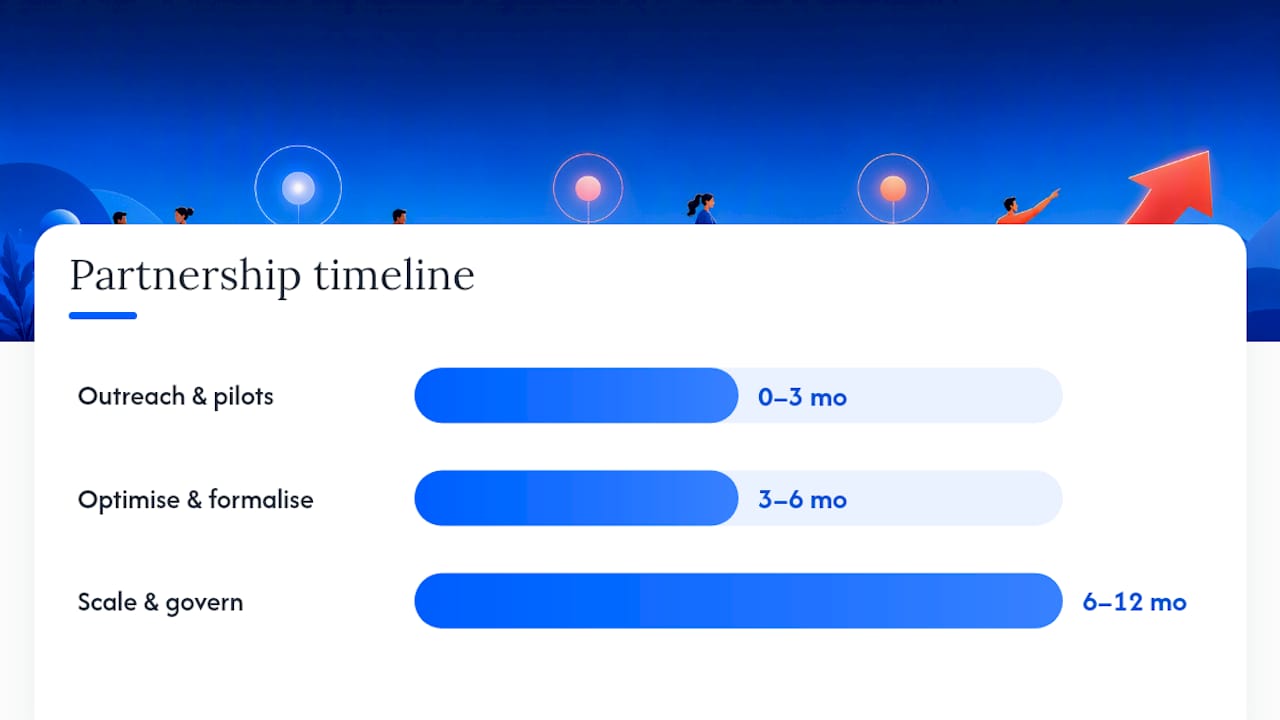
Set expectations early, because partnerships rarely produce revenue in week one. A realistic path runs across three phases.
Starting with a small pilot, such as a guest email or a shared webinar, before committing to a complex revenue split is the safest way to test fit without wasting months.
Cost bands vary depending on how formal you go:
| Cost band | What it typically covers |
|---|---|
| Low (budget range) | Founder time, a basic tracking spreadsheet, informal referral swaps |
| Medium (budget range) | Co-branded assets, a small co-marketing budget, a drafted referral agreement |
| High (budget range) | Legal review of formal agreements, paid co-marketing campaigns, commission payouts at scale |
Most service businesses can start meaningfully in the low or medium band. High-cost formalisation only makes sense once a partnership has already proven it converts.
Most partnerships don’t fail because the idea was wrong. They fail because nobody defined the basics up front.
If a partnership isn’t producing qualified leads after a genuine 90-day pilot, it’s fair to pause rather than push on. Salvage what worked, such as a shared piece of content, and part ways on good terms.
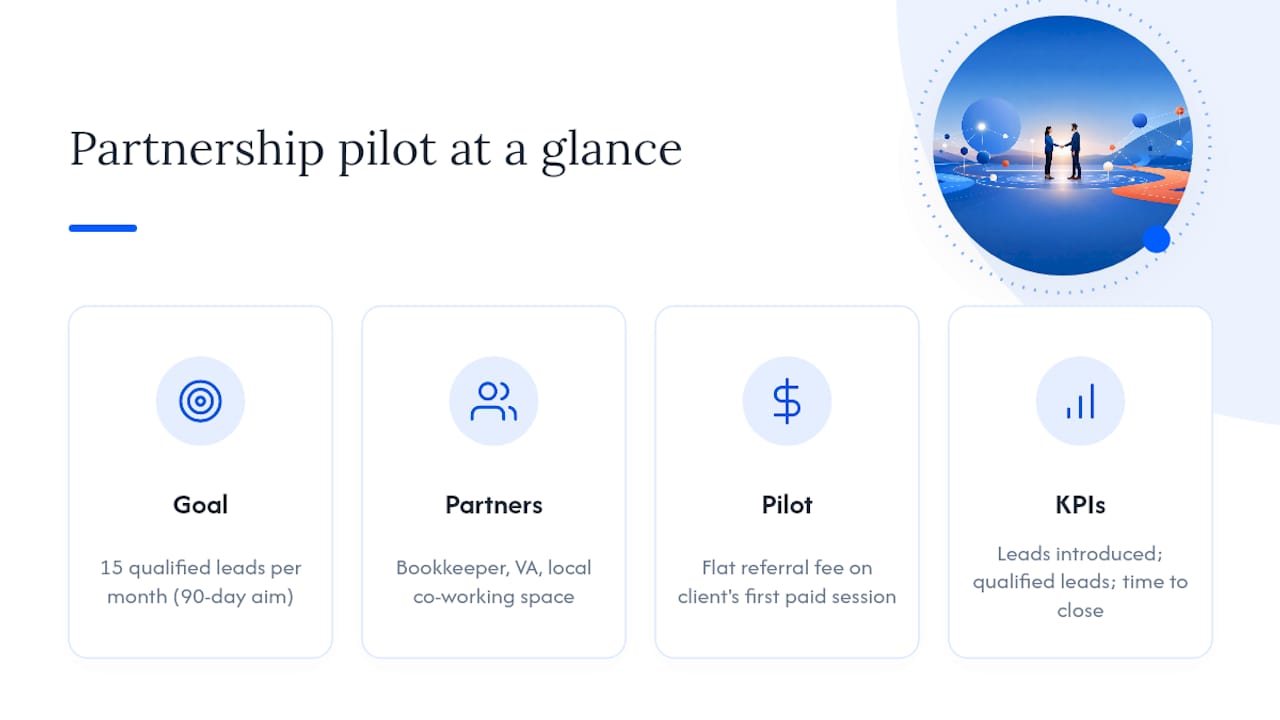
A small business coaching practice working through the Mybworkshops framework set a clear goal: 15 qualified leads per month within 90 days, without increasing ad spend. They mapped three complementary partners, a bookkeeper, a virtual assistant service and a local co-working space, and ran a simple pilot: a shared referral offer with a flat fee triggered on the client’s first paid session.
Within the first pilot cycle, they tracked leads introduced, qualified leads and time to close using the KPI structure outlined earlier. The referral channel became one of their most cost-effective sources of new clients, with far shorter sales cycles than cold outreach because the trust transfer had already happened.
…
Pro Tip: Treat your first partnership pilot as a test, not a launch. A small, well-measured trial tells you more in 30 days than a big, unstructured rollout tells you in six months.
If you want to see how other service businesses have structured their growth systems, the examples of businesses built through workshops page is worth a browse, alongside the growth strategies guide for fitting partnerships into a wider plan.
Keep the outreach message simple: name the overlap between your clients, propose one concrete offer, and suggest a 30-minute call. Measure the pilot against one rule only: did it produce at least one qualified lead that wouldn’t have arrived otherwise?
Mapping partners and drafting agreements is one thing. Running them as part of a proper marketing system, one that also gets your website converting and your offer clear, is what actually compounds results over time. Mybworkshops was built for exactly that gap: structured, expert-led workshops that give service business owners the templates and mentorship to build a whole marketing engine, not just a single tactic.

Inside the program, you get partner outreach templates, a referral agreement checklist you can adapt in minutes, a KPI tracking spreadsheet built for exactly the metrics covered above, and access to a community of other business owners running the same playbook. Rather than guessing whether your referral offer is competitive or your tracking is solid, you’re working from a tested framework alongside people building the same thing.
If you’re ready to put a structured system behind your partnership efforts, browse the workshops archive and find the session that matches where your business is right now.
Partnerships speed up early growth by giving a service business access to a partner’s audience, trust and infrastructure, cutting the time and cost it takes to reach new clients.
Two or three active partnerships is a sensible starting point. Relying on just one creates risk if that relationship ends or slows down.
Yes, even a one-page agreement covering lead definition, payment triggers and confidentiality prevents most disputes before they start.
Expect a genuine pilot to run around three months before you have enough data on leads, conversion rate and revenue to judge whether it’s working.
Mybworkshops workshops include partner outreach templates, a referral agreement checklist and a KPI tracking spreadsheet designed to help service business owners run partnerships as part of a wider marketing system.