

Paid ads stop being profitable when one of three things breaks: you exhaust the cheapest, most obvious buyers first and never replace them, your creative or tracking signal degrades so the platform can’t find good matches anymore, or your funnel leaks people between the click and the sale. Two numbers worth checking today: ad frequency above 3 to 4 on a prospecting campaign signal audience fatigue, and a falling Event Match Quality score on Meta means your tracking data has gone patchy. Your next move isn’t a new campaign. It’s a one-day audit of tracking, conversion rate, and creative performance, in that order.
Quick diagnostic: Before touching your bids or creative, pull your last 30 days of data and check frequency, hook rate, and whether your CRM lead count matches what the ad platform reports. A mismatch there explains more profitability drops than bad targeting ever does.
Pro Tip: Screenshot your core metrics (CPA, ROAS, conversion rate) every Monday. You can’t diagnose a decline if you don’t know what “normal” looked like eight weeks ago.
Paid ads lose profitability when audience exhaustion, creative fatigue, or broken tracking distort your numbers, and fixing the diagnosis in that order restores results faster than changing your strategy blind.
| Point | Details |
|---|---|
| Diagnose before you touch spend | Check tracking accuracy first, since a broken pixel can make a healthy campaign look unprofitable. |
| Watch frequency and hook rate | Frequency above 3 to 4 and declining hook rate both predict rising cost per lead before it happens. |
| Fix the funnel, not just the ad | A slow or unclear landing page often costs more profitability than any bidding issue. |
| Separate market shifts from account problems | Gradual, industry-wide cost rises are competition; sharp, isolated jumps point to your account. |
| Get guided help when you’re stuck | Mybworkshops runs a diagnostic-first workshop covering tracking, creative, and funnel fixes with templates and peer feedback. |
Most profitability drops trace back to a handful of repeat offenders. Once you know the symptoms, you can usually name the cause within minutes of opening your ads dashboard.
A cleaning business we’ll call typical of the pattern might see cost per lead climb noticeably within a several-week period. Nine times out of ten, that’s not the market getting harder. It’s one of the causes above, sitting quietly in the account.
Rising platform-wide costs and account-level problems can look identical on a dashboard, but they behave differently over time. A genuine market shift moves gradually across your whole industry. An account-level problem usually shows up as a sharp, isolated jump in one specific metric while everything else stays flat.
Focus first on what you can control. You can’t fix Meta’s auction dynamics, but you can fix a broken pixel or a stale ad set in an afternoon.
Run this audit in order. Each step tells you whether to keep digging or whether you’ve found your answer.
Step 1: Data integrity. Before anything else, confirm your tracking is accurate. Compare platform-reported leads against your CRM or booking calendar for the same date range. Tracking breakage is one of five systemic causes that most commonly explain a sudden cost-per-lead spike, and it can make a healthy campaign look broken when leads are actually still arriving, just uncounted.
Step 2: Conversion rate and landing page. If tracking checks out, look at what happens after the click. A falling conversion rate with steady traffic quality points to the page, not the ad.
Step 3: Creative and audience signals. Check frequency, hook rate (the percentage who watch past the first three seconds of video), and click-through rate.
Step 4: Bidding and automation. Review whether your bidding strategy has a target or is running unrestricted.
Step 5: Auction competition and seasonality. Only after the above steps come up clean should you look at external market pressure.
Here’s the reference table to work from:
| Metric | What it tells you | Warning sign |
|---|---|---|
| CPA / ROAS | Overall efficiency of spend against results | Rising CPA or falling ROAS over 2+ weeks |
| Conversion rate | Whether the funnel converts clicks to leads | Sudden drop with stable traffic quality |
| CTR | Whether creative and targeting still resonate | Steady decline over successive weeks |
| Frequency | How often the same person sees your ad | Above 3 to 4 on prospecting campaigns |
| CPM | Cost to reach 1,000 people | Sharp rise unrelated to seasonality |
| Event Match Quality | Accuracy of conversion data sent to the platform | Score dropping below “good” |
| LTV | Long-term value per customer | Flat despite rising acquisition cost |
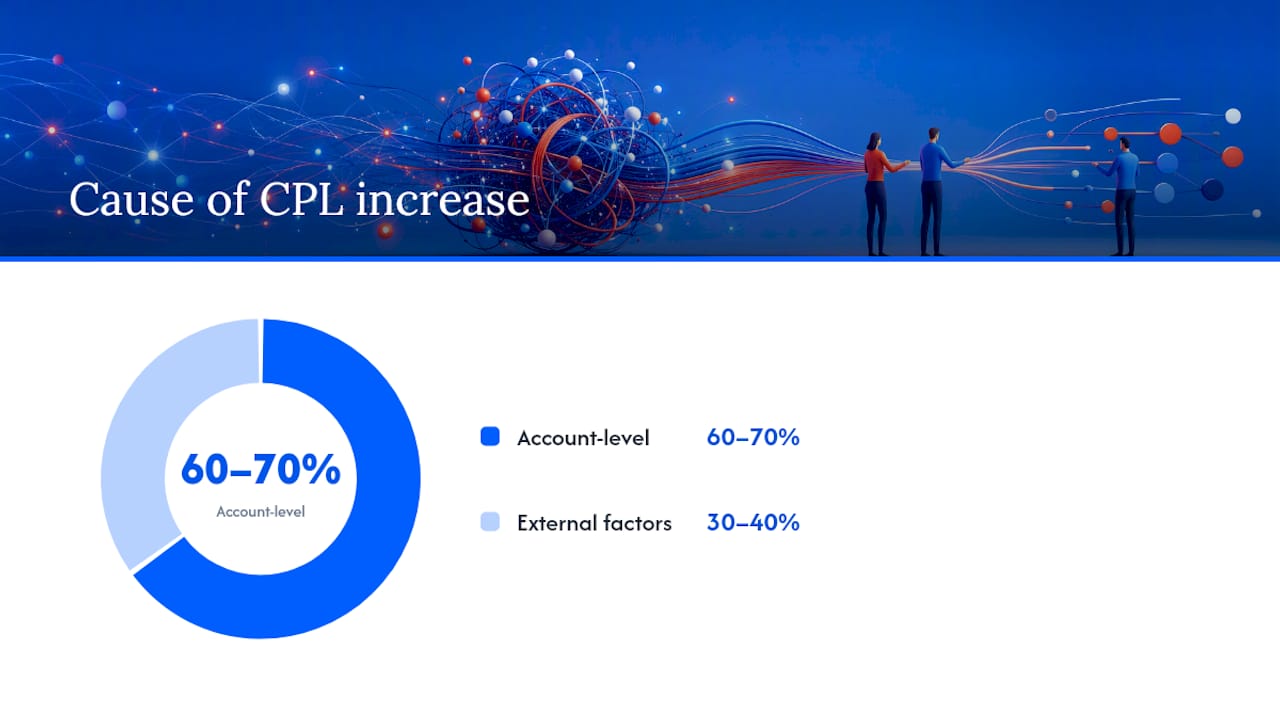
Cost per lead is simply cost per click divided by conversion rate, and account-level factors typically explain 60 to 70% of a CPL increase, even when it feels like the whole market has turned against you. That’s genuinely useful news: it means the fix is usually inside your account, not outside it.
Pro Tip: *Pull up your search term report (Google) or placement breakdown (Meta) and sort by spend.
Quick tests worth running the same day: check whether frequency has crept past 4 in the last fortnight, scan your top three video ads for hook-rate decline, and confirm your server-side or Conversions API events are firing and deduplicated against your browser pixel.
Once you know the cause, work through fixes in this order. Two levers determine your cost per lead: cost per click and conversion rate. Everything below moves one of those two.
For each of these, measure impact over 7 to 10 days minimum before drawing conclusions. Changing five things at once means you’ll never know which one actually worked.
Run through this quick conversion checklist alongside your ad fixes, since it’s usually the difference between a campaign that pays for itself and one that doesn’t:
If your landing page is the weak point, this guide to landing page design walks through the specific elements that move conversion rate, and these five landing page tips cover the fastest wins. If your website generally isn’t converting the traffic you’re paying for, start with this troubleshooting guide.
Quick fixes buy you time. They rarely buy you a business that scales. The deeper levers involve changing your offer, your funnel, and how much a customer is worth to you over time, not just what they cost to acquire.
Start with pricing and packaging. A single, generic service offer forces every prospect to make an all-or-nothing decision. Tiered packages, an entry-level consultation, or a smaller “trial” service give cold traffic a lower-risk way in, which often lifts conversion rate more than any ad tweak.
Lead qualification matters just as much. If your ad sends unqualified traffic straight to a booking form, you’ll pay for consultations that never convert to paying clients. A short qualifying question or a pre-call form filters that out before it costs you time.
Lifetime value is the lever most service businesses ignore. If a client is worth $2,000 across a 12-month relationship rather than a single $400 job, you can afford a higher cost per acquisition and still turn a profit. Retention offers, follow-up sequences, and a simple system for asking happy clients for reviews all push that number up.
If your conversion rate is genuinely low, fix the landing page and offer before you touch the ad account. If your cost per click has risen but conversion rate is stable, the problem is competitive pressure and your creative needs to work harder, not your funnel.
Pro Tip: Ask your last ten clients how they’d describe your service in one sentence. If the answers don’t match your ad copy, that gap is probably costing you conversions.
For a broader look at why disconnected tactics underperform a proper system, this piece on random marketing explains the pattern well.
A test plan only works if your measurement is trustworthy first. Fix these three things before running any structured test: confirm server-side tracking (Conversions API on Meta, Enhanced Conversions on Google) is active, check that conversion events are deduplicated so you’re not double-counting, and make sure your CRM data matches your ad platform’s reporting within a reasonable margin.
Once measurement is solid, work through this roadmap in order:
Keep these guardrails in mind:
Skipping the sample size rule is the most common testing mistake in service businesses. Calling a landing page test after 12 conversions tells you almost nothing.
Set realistic expectations before you start, because some fixes pay back in days and others take months to change your underlying economics.
| Fix | Typical time to impact | Rough cost range |
|---|---|---|
| Tracking repair | 1 to 3 days | Free to a few hours of contractor time |
| Landing page fixes | 3 to 7 days | DIY, or a few hundred dollars for freelance help |
| Creative refresh | 1 to 2 weeks | Free (in house) to a few hundred dollars |
| Bidding structure changes | 1 to 2 weeks to see stable results | Free, time cost only |
| Offer or pricing restructure | 4 weeks | Time cost, plus workshop or program investment |
| Retention/LTV system build | 8 weeks | Ongoing, but pays back through repeat revenue |
Tracking and landing page fixes usually pay for themselves within the first month, because they lower your cost per lead almost immediately. Offer and retention work take longer to show up in the numbers, but change your business economics permanently rather than just this quarter’s ad spend. If your budget is under pressure while you make these changes, this guide to cutting ad spend without losing results is worth reading before you slash anything.
Clear rules stop you making decisions based on a bad Tuesday.
Need a framework for reallocating budget rather than cutting it entirely? This guide to marketing campaigns covers how to shift spend without losing momentum.
A tradie services business came to us with cost per lead that had tripled in two months. The diagnostic found a broken conversion event after a website update, three ads running unchanged for ten weeks, and a mobile page that took nine seconds to load. We worked through the three-phase approach: diagnose the account, apply the quick wins (tracking, page speed, fresh creative), then rebuild their offer into a tiered consultation structure.

Within six weeks: cost per lead dropped by roughly half, and booked consultations lifted noticeably against the same ad spend.
The fix wasn’t the ads at all. It was a landing page rebuild and a clearer, single-sentence offer.
The pattern repeats constantly: business owners assume the ad platform is broken when the real leak is somewhere between the click and the booking form.
This mirrors the diagnostic-first structure Mybworkshops runs in its workshop program: a diagnostic session to find the actual cause, a round of quick wins, then a strategic phase to fix the underlying offer and funnel.
Pro Tip: Before you blame the algorithm, walk through your own funnel on your phone exactly as a stranger would. Most leaks are visible within two minutes.
Sometimes the honest answer is yes, more businesses are bidding for the same customers. When a new competitor enters your local market or a national brand starts advertising in your category, auction prices rise across the board, and everyone’s cost per click climbs regardless of how well their account is run.
Market saturation shows up differently to an account-level problem. It affects your whole industry roughly at the same time, moves gradually rather than overnight, and tends to coincide with an obvious trigger, like a new player launching, a seasonal spike (End of Financial Year for accountants, spring for landscapers), or a broader economic shift changing how freely people spend on services.
The mistake most business owners make here is assuming every cost increase is competition, because it’s the explanation that requires no action on their part. In reality, competitor activity usually explains a portion of a CPL increase, not all of it.
When genuine market saturation is driving costs up, the answer isn’t to keep bidding the same way and hope it settles. It’s to differentiate your offer clearly enough that you’re not competing purely on price per click, and to lean harder on retention and referrals so you’re less dependent on winning every fresh auction. A business with strong repeat clients feels a competitive squeeze far less than one that needs a constant stream of brand-new customers.
Most service businesses run all their spend through a single channel, usually Meta or Google, without ever testing whether that’s actually the best use of the money. That’s not a diversification problem so much as a measurement gap. You can’t optimise budget allocation you’ve never actually tested.
Start by looking at cost per lead and lead quality by channel, not just total lead volume. A channel producing cheap leads that never book a consultation is worse than a channel producing fewer, pricier leads that convert reliably. If you’re running both Google Search and Meta, compare not just CPL but what happens after the lead comes in.
This tells you far more than watching platform dashboards separately, because it forces an apples-to-apples comparison on the metric that actually matters, revenue.
Within a single platform, the same logic applies to campaigns. A monthly budget review, even a rough one, catches this before it compounds into a quarter of wasted spend.
Basic demographic and interest targeting gets you in the game, but it rarely sustains profitability once your account matures. The businesses that keep ads profitable longer tend to segment by behaviour and intent, not just age and location.
Practical segmentation for a service business starts with separating warm audiences from cold ones. People who’ve visited your pricing page in the last 30 days, past clients, and your email list are fundamentally different prospects to someone who’s never heard of you. Running the same ad and offer to both groups wastes budget on one side or the other.
From there, personalisation doesn’t need to be complicated. A landing page that changes its headline based on which ad someone clicked (referencing the specific service they searched for, rather than a generic homepage) consistently lifts conversion rate. Sending past clients a different offer to first-time visitors, like a referral incentive instead of a discovery call, respects where they already sit in the relationship.
The mistake to avoid is over-segmenting too early. Splitting a modest budget across a dozen tiny audience segments starves each one of the volume the algorithm needs to optimise properly. Start with two or three meaningful segments, ideally warm versus cold versus past client, get those working, then add nuance once you have enough conversion data to justify it.
Automated bidding and AI creative tools genuinely speed up parts of ad management, but they work best as an assistant to a strategy you already understand, not a replacement for one. Smart Bidding, for example, can find efficiencies a human manually adjusting bids would miss, provided you’ve given it a sensible target and enough conversion data to learn from.
Where automation helps most is creative testing cycles. Dynamic creative tools that automatically mix headlines, images, and copy can surface a winning combination faster than manually building and comparing dozens of ad variations by hand. AI copywriting tools can also generate a wider spread of headline and hook options to feed into that testing process, which matters given how quickly hook rate decline signals fatigue before cost per lead visibly rises.
Where automation causes damage is when it’s left unsupervised on a badly configured account. Automated bidding with broken tracking will optimise toward the wrong outcome, confidently and at scale. AI-generated creative without a clear brand voice or offer behind it produces ads that look polished but say nothing memorable. Treat automation as a way to execute your strategy faster, never as a substitute for knowing your offer, your audience, and your numbers. If you want a grounded look at where AI genuinely helps a small business marketing system versus where it doesn’t, this practical breakdown is worth a read.
Everything above is doable on your own with a spreadsheet, a Monday afternoon, and some patience. But if you’d rather work through the diagnosis with someone who does this for a living, and walk away with templates instead of guesswork, that’s exactly what a Mybworkshops workshop is built for.

Our workshops don’t sell you a quick fix. You get a structured diagnostic session to find what’s actually driving your ad costs up, hands-on time fixing tracking, creative and landing page issues, and templates you keep using long after the session ends, alongside feedback from other service business owners working through the same problems. The goal is a marketing system that keeps working once the workshop’s over, not a temporary bump in your numbers.
If your ads are the specific pain point, Drive Traffic & Get Clicks That Count walks through exactly the diagnostic and fix process covered here, with direct support along the way. Have a browse of the full workshop range and book the one that matches where your business is stuck right now.
Yes, for most service businesses, provided your offer, funnel, and tracking are solid. Ads mostly capture existing buyer intent rather than creating it, so profitability depends as much on your business fundamentals as on the platform itself.
Tracking fixes and landing page patches can show impact within days, but a full recovery to stable profitability usually takes two to six weeks depending on what’s broken. Rushing the diagnosis to hit a shorter timeline tends to produce the wrong fix.
Check whether the cost increase is industry-wide and gradual (competition) or sudden and isolated to your account (a funnel or tracking problem).
Missing or duplicated conversion events, often after a website update, that make platform-reported results diverge from what’s actually happening in your CRM or bookings. Comparing the two figures regularly is the simplest way to catch this early.
They can work well when the account has clean tracking, fresh creative, and a landing page built for the offer being advertised. Performance issues on these platforms usually trace back to creative fatigue or signal degradation rather than the platform losing effectiveness overall.