
The follow-up that actually closes deals is a short, personalised sequence of five to eight touches, each one carrying a single, specific ask. Not a weekly “just checking in”, not a wall of text hoping something sticks. One clear next step, sent on a rhythm the prospect can predict.
The evidence backs this up. Most sales cycles need about eight touches to secure a first meeting with a cold prospect, and the emails that get replies sit in the 50 to 125 word range, short enough to read on a phone while walking to a meeting.
Pro Tip: If you’ve just come off a call or demo, send your recap follow-up within two hours. Momentum fades fast, and a same-day note reads as attentive rather than automated.
If you only do one thing after reading this, do this: pull up your last three “no reply” leads and send the same-day recap template from the next section, then commit to an 8 touch cadence over three to four weeks for every new lead going forward. Everything else in this guide builds on that single habit.
A short, personalised sequence of five to eight touches with one clear ask per email consistently outperforms both single follow-ups and generic mass “checking in” blasts.
| Point | Details |
|---|---|
| Aim for eight touches | Cold prospects often need multiple touches before booking a first meeting. |
| Keep emails short | Target 50 to 125 words so the message reads easily on mobile. |
| Send post-call recaps fast | Follow up within two hours of a call or demo to keep momentum and clarity. |
| Front-load early touches | Space touches 1 to 4 closer together, then widen the gap for later ones. |
| Use the breakup email deliberately | A direct “should I stop reaching out?” question often prompts the highest reply rate in the sequence. |
You don’t need twenty different templates. You need four or five that cover the real moments where deals stall, written in a voice that sounds like you, not a script. Below are the ones worth keeping in your drafts folder, organised by where the prospect sits in the conversation.
Cold follow-ups need to feel like a continuation, not a new pitch. Keep the signal-to-noise ratio high: one observation, one reason it matters to them, one question.
Touch 1 follow-up (3–4 days after initial email):
Subject: Following up on [specific detail]
“Hi [Name], wanted to bump this up in your inbox. [One-line observation about their business, e.g. ‘Saw your team’s expanding into Perth this quarter.’] Worth a quick chat about how [specific outcome] might fit into that? Happy to work around your schedule.”
Touch 2 follow-up (day 7–8, add a value nugget):
Subject: Re: Following up on [specific detail]
“Hi [Name], one thing I didn’t mention last time: [short stat, case reference, or resource link relevant to their industry]. If timing’s off right now, no drama. Just let me know and I’ll check back in a few weeks.”
Touch 3 follow-up (day 12–14, direct ask):
Subject: Quick question
“Hi [Name], is [problem/goal] still something you’re working through? If yes, I’ve got 15 minutes free Thursday or Friday. If not, tell me and I’ll stop cluttering your inbox.”
This is the most important email you’ll send in the whole sequence, and it should go out the same day. Sending your first follow-up within two hours of a call, where possible, is one of the most reliable ways to keep momentum and avoid the prospect’s memory of the conversation going soft.
“Hi [Name], great chatting today. Quick recap: you’re looking to solve [specific problem], and we talked through [solution/feature] as the fit. Attached: [case study/pricing overview if discussed, and a one-page summary of what was agreed]. Next step on my end is [specific action]. Can you confirm [date] works for [next step]?”
Attachments checklist: relevant case study, pricing overview if discussed, and a one-page summary of what was agreed. Nothing more. A five-attachment email reads as disorganised, not thorough.
Once a proposal’s out, the follow-up needs one job: get a decision, not just a read receipt.
“Hi [Name], following up on the proposal sent [date]. Wanted to check whether [specific line item, budget, or timeline] needs any adjustment before we move forward. I can hold the current terms until [specific date] if that helps with planning. Keen to hear where things sit.”
Time-boxing the offer isn’t a pressure tactic. It gives the prospect a genuine reason to reply instead of letting the email sit in a “later” pile indefinitely.
When touches 1 through 6 haven’t landed a reply, the breakup email does double duty: it often gets the highest reply rate of the whole sequence, and it gives you a clean reason to move the lead into a longer-term nurture list rather than keep pestering.
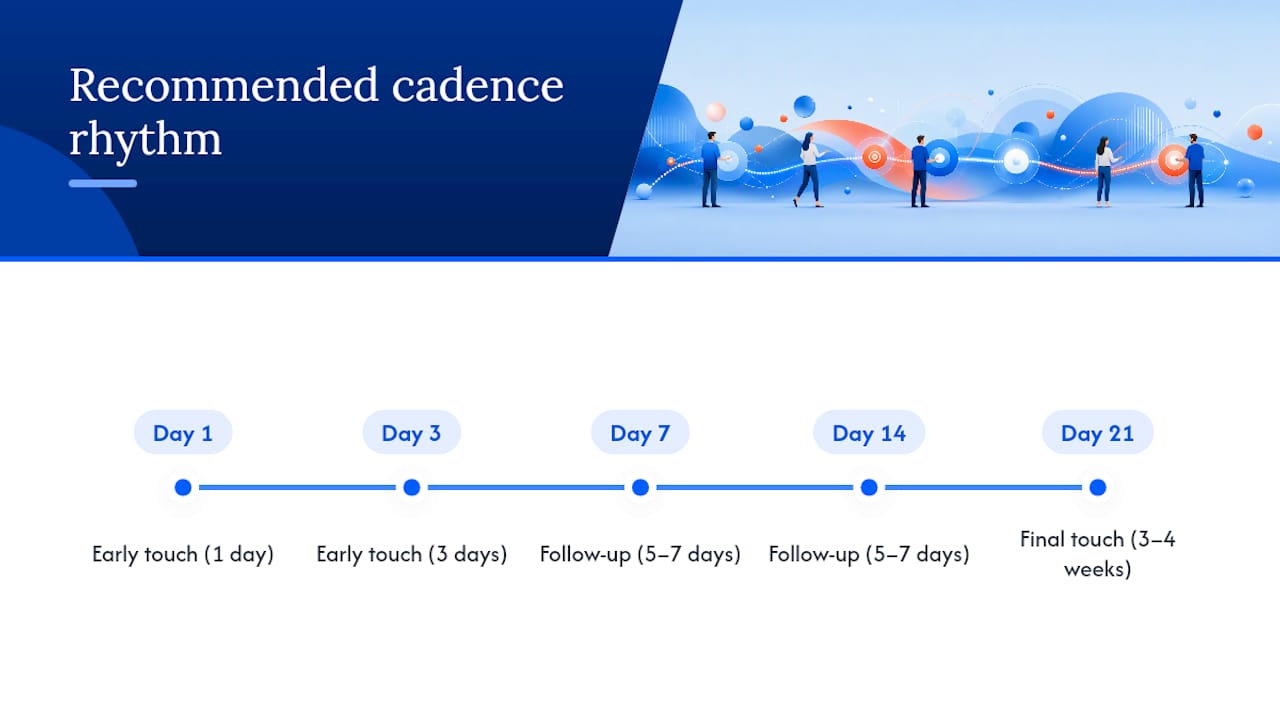
A cadence isn’t a countdown, it’s a rhythm designed to match how prospects actually process decisions. Front-load the early touches close together, then stretch the gaps as the sequence progresses. That front-loading pattern, tighter spacing in the first week and longer gaps later, is consistently recommended across cadence frameworks because early attention fades fast if you don’t reinforce it quickly.
Adding a short personalised video on one or two of those touches, especially touch 1 or the mid-sequence check-in, isn’t just a novelty. Sendspark’s customer data shows personalised video steps can produce significantly higher reply rates than text-only messages than text-only messages, provided the video actually references the prospect by name or detail rather than being a generic recorded pitch.
Warm leads move faster and need less convincing, more logistics. A typical structure looks like this:
Keep touches 1 to 4 within one to four days of each other, then widen to five to seven days for anything after that. This isn’t arbitrary. It mirrors how attention and urgency decay over a sales cycle: tight early spacing catches momentum while it’s still warm, and wider later spacing avoids looking desperate.
Set exit conditions before you start the sequence, not after. A common rule: if there’s no reply after the breakup email, move the contact into a slower, ambient nurture track rather than deleting them from your pipeline entirely.
Best days and times: Tuesday through Thursday mornings tend to outperform Monday (inbox backlog) and Friday afternoon (mental checkout). This isn’t a hard rule, but it’s a sensible default when you don’t have your own open and reply data yet, which is exactly the kind of data you should start tracking from your very first cadence.
Structure matters more than length. A follow-up email has four working parts, and each one has a job to do.
Aim for a total length of 50 to 125 words for most follow-ups. That range consistently outperforms longer messages because most people are scanning email on a phone between meetings, not sitting down to read a proposal. If your follow-up needs more than 125 words to make its point, that’s usually a sign the point belongs in an attachment, not the email body.
The subject line’s only job is to earn the open. It doesn’t need to sell anything. A few formats consistently outperform the generic “Checking in”:
Personalisation isn’t inserting a first name into a merge field. That’s table stakes, and prospects can spot it from a mile away. Real personalisation that changes reply rates works in three layers.
Surface layer is what most templates already do: name, company, industry. It’s necessary but not sufficient on its own.
Context layer, sometimes called the middle layer, references something specific and current: a recent announcement, a comment from the demo call, a detail from their website updated in the last month. This is where most sales emails should live, and it’s achievable in under two minutes per prospect if you check their LinkedIn activity or company news page before sending.
Deep narrative layer ties your message to the prospect’s longer-term goals, not just their immediate problem. This takes more research and isn’t practical for every touch in a high-volume cadence, but it’s worth doing for your top accounts. Personalisation has to speak to where the prospect is heading, not just where they are today, because surface-level personalisation alone consistently under-delivers on reply rates.
Pro Tip: Before sending any personalised line, ask yourself: could I explain exactly where I got this detail if the prospect asked? If the answer’s no, don’t include it. Inventing or guessing at a signal is worse than skipping personalisation altogether.

For scale, a hybrid model works best: build your templates in the CRM, but add a manual verification step where a real person checks the personalised line before it goes out. Overloop’s analysis of high-performing sequences found templates paired with human verification consistently outperform fully automated personalisation, because automated systems still make embarrassing factual errors often enough to damage trust.
Silence doesn’t mean no. It usually means “not now,” and the way you handle that gap determines whether the lead is recoverable in three months or gone for good.
Ambient exposure is the underrated tactic here. Repeated, low-stakes touches across channels, a LinkedIn comment, a helpful share, a short check-in, build familiarity even when nobody’s replying. This works on the mere-exposure effect: repeated, varied exposure increases recognition and eventual engagement, and it protects your deliverability because you’re not hammering the same inbox with identical cold emails.
Pattern interrupts break the “another sales email” pattern without asking for anything:
When the breakup email genuinely gets no response, don’t delete the contact. Re-enter them into your pipeline after 60 to 90 days, ideally triggered by a real event: a funding announcement, a role change, a seasonal pattern in their industry. Cold re-entry without a trigger reads as spam; trigger-based re-entry reads as attentive timing.
Track five numbers, and track them by cadence stage, not just in aggregate:
Cold cadences typically need around eight touches before landing a first meeting, so don’t judge a sequence as failed after two emails. Warm, post-demo cadences convert faster and need fewer touches, which is exactly why they’re structured differently in the cadence table above.
Run one variable at a time: test subject line format one month, opener signal the next, CTA phrasing after that. Log every result against the specific template version in your CRM so you know which change actually moved the number, not just which month happened to be busier. If you’re consistently seeing opens but no replies, the problem is usually your value line or CTA, not your subject line. For a deeper look at where conversion actually breaks down in email sequences, our piece on boosting email conversion rates covers the diagnostic side of this in more detail.
Templates get you started. A system is what keeps your follow-ups working after the novelty wears off, and that’s the gap Mybworkshops’ three-phase approach is built to close.
Plan: before writing a single template, we work through who the follow-up is actually for. A cadence built for a rushed tradie enquiry looks nothing like one built for a considered B2B proposal, and most businesses skip this step entirely, then wonder why their “proven” template underperforms.
Build: this is where the templates and cadence tables above turn into an actual working sequence in your CRM, matched to your brand voice rather than a generic script. It’s also where segmentation earns its keep. Our guide on email list segments is a useful starting point if your follow-ups are currently one-size-fits-all.
Measure: the metrics section above only matters if someone’s actually reviewing the numbers each month and adjusting. This is the phase most solo operators drop, not because they don’t care, but because nobody’s holding the loop closed.
Practical next steps you can take this week, alone or with structured support:
Business owners working through our lead generation sales flow and nurture system workshop build exactly this kind of cadence as part of a broader system, not as an isolated email trick.
| Phase | Focus | Reader action |
|---|---|---|
| Plan | Match cadence to buyer type | Identify which of your leads are cold vs warm this week |
| Build | Turn templates into a live sequence | Load the 8-touch cadence into your CRM |
| Measure | Track and iterate | Review reply rate monthly and adjust one variable |
The cadences and benchmarks in this guide draw on a handful of specific sources rather than general assumptions:
A good follow-up sales email is short (50 to 125 words), references something specific about the prospect, and ends with one clear, low-friction ask rather than several options to consider.
Definitions of the 2-2-2 rule vary across sales teams, and it isn’t a standard covered by the research behind this guide, so treat any specific version you encounter as one team’s internal shorthand rather than an industry-wide rule.
Reference the previous conversation or email directly, state why you’re following up in one line, and give the reader an easy way to say “not now” as well as “yes.” Politeness in follow-ups comes from making it easy to decline, not from over-apologising.
Phrases like “circling back,” “wanted to check in on,” or simply replying in the same thread with “Re:” all read as professional. The subject line itself doesn’t need the words “follow up” at all, a reply-thread or two-word subject often performs better.