

20 Copy Ready Value Proposition Examples for Australian Services

Australian business owner comparing headline drafts

A value proposition is the one sentence that tells a customer what they get, who it’s for, and why it beats doing nothing. This guide gives you real, copy-ready value proposition examples across a dozen industries, four fill-in-the-blank templates, and a short note on keeping your claims provable under Australian Consumer Law.


TL;DR:

  • Most effective value propositions name a specific audience, state a measurable outcome, and include a proof point that reassures the customer.
  • Using clear, outcome-focused language like “same-day callout” or “reconciled by the 20th” is more impactful than vague terms like “quality” or “luxury.”
  • Testing headlines through simple A/B tests and customer feedback helps identify which claims resonate and drive action.
  • Every claim must be backed by verifiable evidence to comply with Australian Consumer Law and avoid future legal issues.
  • Tailoring proof cues and language to sector-specific customer doubts ensures the message addresses buyer hesitation effectively.

Mybworkshops
Turn Clear Messaging Into Growth
MYB Workshops help service-based business owners improve positioning, websites, and marketing with expert-led, actionable strategies.

Explore MYB Workshops

Table of Contents

Value proposition examples worth stealing (and adapting)

A good value proposition isn’t clever. It’s clear. The best ones tell a stranger, in under ten seconds, exactly what they’re getting and why it matters to them specifically. Below are 20 examples across the categories where Australian business owners most often get stuck: SaaS, subscriptions, professional services, local trades, e-commerce, marketplaces, and B2B. None of these name real competitors. Each one uses a category label so you can see the pattern without copying a brand.

Notice the shape. Every strong example names the audience, states the outcome, and gives a reason to believe it. Drop any one of those three, and the line turns into a slogan instead of a value proposition.

  1. Project management SaaS (small teams): “Run your whole project from one screen, without the 40 tabs.” Audience: solo operators and small teams drowning in spreadsheets. Proof cue: a live dashboard screenshot, not a testimonial quote.
  2. Accounting software for tradies: “Send an invoice from the job site in under 60 seconds.” Audience: tradespeople who bill from their ute. Proof cue: a timer graphic showing the exact steps.
  3. Email marketing platform: “Write one email. We turn it into five, tailored to each subscriber.” Audience: solo marketers with no time for segmentation. Proof cue: a before/after subject line comparison.
  4. Subscription meal box: “Dinner sorted for four nights, no shopping list required.” Audience: busy parents who hate meal planning. Proof cue: weekly menu photos with prep time listed.
  5. Streaming fitness app: “Twenty minutes, no gym, no judgement.” Audience: beginners intimidated by traditional gyms. Proof cue: session length shown on every thumbnail.
  6. Subscription razor service: “Fresh blades on your doorstep before the old ones go blunt.” Audience: people who forget to restock. Proof cue: a delivery schedule tied to average blade life.
  7. Bookkeeping service for sole traders: “Your books done by the 5th of every month, guaranteed.” Audience: sole traders who dread tax time. Proof cue: a fixed monthly delivery date, stated plainly.
  8. Business coaching for tradies: “Turn your trade skills into a business that runs without you standing on site.” Audience: tradies stuck doing the work instead of running the business. Proof cue: a before/after of hours worked per week.
  9. Copywriting freelancer: “Website copy that reads like a person wrote it, because one did.” Audience: business owners tired of generic AI-sounding text. Proof cue: a side-by-side writing sample.
  10. Virtual assistant service: “Ten hours of admin off your plate, every single week.” Audience: solo business owners buried in email. Proof cue: a weekly task log template shown as a sample.
  11. Local electrician: “Same-day callout for anything that trips your switchboard.” Audience: homeowners with an urgent electrical fault. Proof cue: a stated response window, not just “fast”.
  12. Mobile dog groomer: “Your dog groomed in your driveway while you work from home.” Audience: pet owners who hate the salon drop-off routine. Proof cue: a booking calendar showing typical wait times.
  13. Local physiotherapy clinic: “Back on the field in six weeks, with a plan that says how.” Audience: weekend sports players with a soft tissue injury. Proof cue: a sample rehab timeline.
  14. Handmade skincare brand: “Three ingredients, no fillers, made in small batches weekly.” Audience: shoppers wary of long ingredient lists. Proof cue: the ingredient list itself, printed in full on the product page.
  15. Sustainable homewares store: “Furniture built to outlast the lease you bought it for.” Audience: renters buying furniture they’ll take with them for years. Proof cue: a stated warranty period.
  16. Online marketplace for local makers: “Buy from the maker down the street, not a warehouse interstate.” Audience: shoppers who want to support local production. Proof cue: a seller location shown on every listing.
  17. Freelance marketplace for tradies: “Quoted, booked and on the calendar in one phone call.” Audience: homeowners tired of chasing three quotes. Proof cue: an average response time stat, if you have one to prove.
  18. B2B logistics software: “Know where every pallet is, without calling the warehouse.” Audience: operations managers chasing shipment updates by phone. Proof cue: a live tracking map screenshot.
  19. B2B recruitment agency: “Three qualified candidates in five business days, or we keep looking free.” Audience: hiring managers who’ve been burned by slow agencies. Proof cue: the guarantee, stated in writing.
  20. Commercial cleaning contractor: “One contract, every site, one invoice.” Audience: multi-site business owners juggling separate cleaning contracts. Proof cue: a sample consolidated invoice.

Read through that list again and you’ll notice something: almost none of them use the word “quality,” “innovative,” or “best.” Those words say nothing a customer can picture. “Same-day callout” and “six weeks” do the work instead.

A value proposition formula you can fill in today

You don’t need a brand strategist to write a decent value proposition. You need a formula, ten minutes, and the willingness to cut every word that doesn’t earn its place. The academic research behind the Value Proposition Canvas backs this up: propositions work best when they map a specific customer job, pain, or gain to a specific thing you do about it, not a general claim about your business.

Here are four templates. Pick the one that fits your business type, not the one that sounds most impressive.

  • The short headline: “[Outcome] for [audience], without [common frustration].” Example: “A tidy office, without the Saturday cleaning roster.”
  • The expanded headline: “[Product/service] helps [audience] [achieve outcome] by [mechanism], so they can [bigger benefit].” Example: “Our bookkeeping service helps sole traders stay tax ready by reconciling weekly, so they can stop dreading July.”
  • The job-to-be-done formula: “When [audience] needs to [job], [business] delivers [outcome] through [differentiator].” Example: “When a landlord needs a property re-let fast, our agency delivers a signed lease in 14 days through same-week open homes.”
  • The outcome + evidence formula: “[Outcome], [proof point].” Example: “98% of invoices paid within 7 days, because we chase them so you don’t have to.”

Before and after, service business: Before: “We provide expert accounting solutions tailored to your business needs.” After: “Your BAS lodged, reconciled, and off your plate by the 20th of every month.”

Before and after, SaaS: Before: “An innovative platform to streamline your workflow.” After: “See every overdue task across your team in one list, updated live.”

Before running with any headline, check it against three things: does it name a specific audience, does it state a measurable outcome, and does it name what makes you the one to deliver it? If you can’t answer all three, keep rewriting.

Pro Tip: Write five versions of your headline before you pick one. The first draft almost always describes what you do. The fifth draft usually describes what the customer gets, which is the version that converts.

Business Queensland’s guidance on clarifying your customer value proposition makes the same point: a proposition that tries to say everything ends up saying nothing, and businesses are generally better served focusing on one core promise rather than several competing ones.

How to adapt your value proposition by sector

The formula stays the same across industries. What changes is which proof cue actually lands with that buyer, and which words sound tone-deaf if you get the register wrong.

Professional services. A financial adviser might write “Retire on your terms, with a plan reviewed every year, not just once.” A migration agent might write “Your visa application reviewed by someone who’s lodged 400 of them, not a template.” Tone: calm, specific, low on urgency. Buyers in this category are wary of hype, so lean on credentials and process detail over adjectives.

SaaS and B2B. A scheduling tool: “Fill your calendar gaps automatically, before a client even asks.” A B2B supply platform: “Reorder stock in two clicks, restocked within 48 hours.” Tone: efficiency-focused, numbers-heavy. Buyers here want to see the mechanism, not just the outcome, so name the “how” briefly.

E-commerce and retail. A candle brand: “Scented for eight hours, not two, because we don’t cut the wax with filler.” A clothing label: “Sized for real bodies, tested on 50 women before it ships.” Tone: sensory and specific. Vague premium language (“luxury,” “artisanal”) is where this category gets sloppy, so anchor every claim to a fact you can show.

Local and trades. A plumber: “Fixed same day, or the callout’s free.” A landscaper: “Your lawn mowed on the same day every fortnight, rain delays texted ahead.” Tone: reliability over polish. Local buyers care more about turning up on time than clever wording.

Whatever sector you’re in, the proof cue has to match the buyer’s biggest hesitation. Trades buyers worry about no shows. SaaS buyers worry about setup time. Match the evidence to the doubt, not to what’s easiest to brag about.
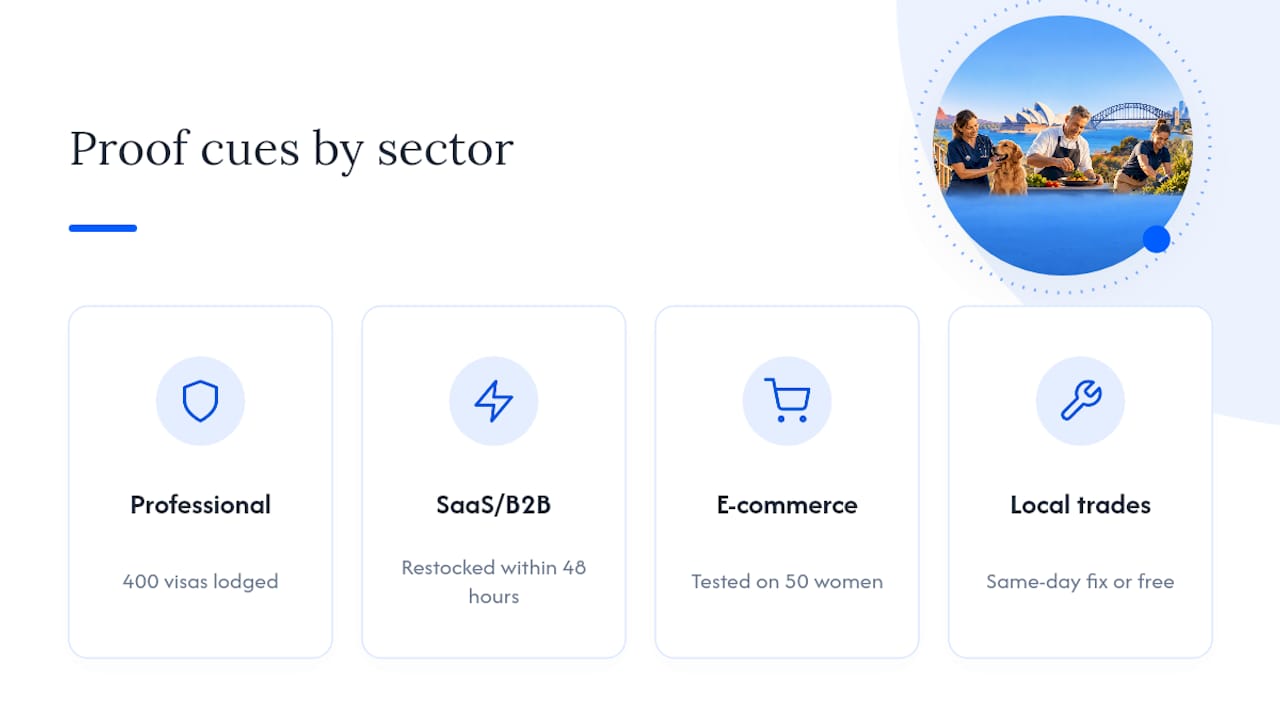
How to adapt your value proposition by sector — overview diagram

Testing your value proposition before you commit to it

You don’t need a data team to find out if a headline works. You need a few weeks, a way to track clicks, and the discipline to change one thing at a time.

  1. Run a simple A/B test on your hero headline. Split traffic between two versions, keep everything else on the page identical, and run it for at least two weeks to smooth out day-to-day noise.
  2. Watch click-through on the primary call-to-action, not just page views. A headline that gets attention but doesn’t move people to click the button hasn’t done its job yet.
  3. Ask five past customers a three-minute question, worded like this: “What almost stopped you from booking with us?” Their answer often becomes your next headline.
  4. Run a quick customer interview on the phrase itself: read them two versions and ask which one sounds like something they’d actually say to a friend.
  5. Track the result against a baseline metric, whether that’s enquiry form submissions, quote requests, or add-to-cart rate, over a four to six week window before declaring a winner.

Pro Tip: Change one variable at a time. If you rewrite the headline and swap the photo in the same test, you’ll never know which one moved the number.

Making claims you can prove under Australian law

A value proposition that sounds great but can’t survive a follow-up question is a liability, not an asset. Under Australian Consumer Law, the ACCC requires that claims about value, benefits or quality be truthful, accurate and backed by reasonable grounds, and businesses have faced real penalties for representations that couldn’t be substantiated.

This matters even more for sustainability and premium claims, where the ACCC specifically warns businesses to be clear, specific, and upfront about conditions rather than relying on vague, feel-good language.

  • Vague: “Eco-friendly packaging.” Provable: “Packaging made from 80% recycled cardboard, verified by our supplier’s certification.”
  • Vague: “Australia’s best coffee.” Provable: “Roasted within 48 hours of order, direct from the farm we’ve bought from since 2019.”
  • Vague: “Fast turnaround.” Provable: “Quotes sent within 4 business hours, tracked and reported monthly.”

Keep an evidence log for every specific claim on your website: the date, the metric, the source, and where it’s published. If a claim can’t be backed by something in that log, rewrite it as a promise you can actually keep, or drop it. It’s a small habit that protects the business long after the marketing campaign ends.

Turning a good headline into a system that keeps working

Writing one strong value proposition is a good afternoon’s work. Making sure it’s backed by a clear business direction, a website that actually supports it, and messaging that stays consistent across every page is a different job entirely, and it’s the gap where most small business owners get stuck.

[Call to action image illustrating the process]

That’s the exact gap Mybworkshops was built to close. Rather than handing you another template and wishing you luck, the Clarify Your Messages & Attract the Right Clients Workshop walks you through building one core value proposition that fits your actual business, not a borrowed formula, and the Compelling Homepage Copy Workshop shows you how to carry that same message onto the page where it needs to convert. Both sit inside a structured, step-by-step program that blends personal mentorship with practical templates and AI tools built for real business owners, with 12 months of access and a supportive community behind every session.

Workshop participants get:

  • A single, tested core value proposition instead of five competing headlines.
  • Copy templates they can reuse across their homepage, service pages, and ads.
  • Direct access to guided feedback instead of guessing whether their wording is working.

If you want the strategy foundation before the messaging work, the #1 Business Strategy Workshop is available, and current prices are on the pricing page. Browse the full workshop catalogue and book the session that matches where you’re stuck right now.

Sources

FAQ

Can you give examples of value propositions?

Yes. Effective examples name a specific audience, a measurable outcome, and a proof point, such as “same-day callout for anything that trips your switchboard” for an electrician or “your BAS lodged and reconciled by the 20th of every month” for a bookkeeper. The 20 examples above cover SaaS, retail, trades, and professional services.

What are the key elements of a value proposition?

A strong value proposition needs a clear audience, a specific outcome, and a reason to believe you can deliver it, sometimes called proof or evidence. The Value Proposition Canvas research frames this as aligning the customer’s job, pains and gains with what you actually offer to relieve or create them.

How do I write my own value proposition?

Start by naming one customer job you solve, then use a template such as “[Outcome] for [audience], without [common frustration].” Draft five versions, test the strongest two against real traffic or real conversations, and keep the one that gets a clearer reaction.

What is a value proposition in simple terms?

It’s the one sentence that answers a customer’s unspoken question: what’s in it for me? It’s not a slogan or a tagline, and it’s not a list of features. It’s a specific promise about the outcome someone gets from choosing you over doing nothing.

How is a value proposition different from a tagline?

A tagline is a brand-recognition device, often abstract and built to be memorable over years, such as a short phrase used across all marketing. A value proposition is functional: it states a specific outcome for a specific audience, and it can and should be tested and rewritten as your offer changes.


Hi There, I'm Peggy

I’m the brains (& the energy) behind MYB Workshops.

For 20+ years, I’ve helped business owners ditch the confusion, clarify their message, and build brands that attract the right clients. No fluff, no overwhelm, just proven strategies that work.

If you want to build a brand that feels right and actually brings in business, you’re in the right place!

Hi There, I'm Peggy!

For more than 20 years, I’ve helped businesses grow with better marketing systems that support long-term plans.

Everything inside MYB Workshops is built from the same strategies, frameworks and practices we use in our agency. These aren’t theories or quick fixes. They’re proven approaches shaped by real-world results and applied across hundreds of businesses.

MYB Workshops was created to make those tools and insights accessible to business owners who want greater clarity and confidence in their business.

I’m glad you’re here in the Blog, explore some of the hot topics our clients ask us about. I hope to see you in the workshops, real soon!

Build Your Business

If your business isn’t attracting and converting the right customers, something needs to change.

In MYB Workshops, you get proven strategies, expert guidance, and a clear plan that actually works. 

Start building a marketing system that works, today!

Stop Losing Sales

Brand confusion costs sales. Learn how to position, market, and sell with confidence inside MYB Workshops.

FREEBIES
FREE Brand Clarity Workshop

Crafting Your Brand Identity 

An on-demand workshop to help you create a brand identity that attracts the right clients, builds trust, and drives real results, without the guesswork.

PLUS Grab your FREE workbook to implement everything instantly!

6 Strategies to Build a Website That Converts

3 seconds. That’s all it takes for a visitor to decide if they’ll stay or leave your website.

Download this FREE guide to learn 6 proven strategies to keep visitors engaged and turn them into paying clients.

FREE Branding Guide

Your brand is more than a logo. It’s the foundation of your entire business.

If you skip this step, you risk wasting time and money on marketing that doesn’t convert.

Download this FREE guide and discover 5 key steps to build a brand that attracts, connects and drives long-term success.

Related Blog Articles