

SEO is the primary mechanism that brings potential clients to your website without you paying for every click. Organic search accounts for around 53% of all website traffic, making it the single largest traffic channel for most Australian service businesses. If your website isn’t ranking, you’re invisible to people who are already looking for what you offer.
Three things make SEO worth understanding right now:
Pro Tip: Claim and fully complete your Google Business Profile this week. It’s the single fastest local SEO win available to any Australian service business, and it costs nothing but time.
SEO traffic, or organic traffic, refers to visitors who arrive at your website by clicking an unpaid search result on Google or another search engine. No click fee, no ad spend, just your site appearing because it’s relevant to what someone searched.
The distinction matters for your marketing decisions. Paid search (Google Ads) puts you at the top of results immediately, but every click has a cost and visibility disappears the moment you stop spending. Referral traffic comes from other websites linking to yours, and social traffic arrives from platforms like Instagram or Facebook. Organic search sits apart from all of these because it improves visibility and attracts targeted visitors over time, building an asset rather than renting attention.
Where you’ll see each type in practice:
The compounding nature of organic traffic is what separates it from every other channel. A well-optimised service page can rank and generate enquiries for years after you publish it. Paid ads reset every billing cycle.
SEO works through four interconnected mechanisms. Understanding each one helps you see which part of your website or marketing is doing the heavy lifting, and where the gaps are.

This covers everything on your actual web pages: the words, headings, page titles, meta descriptions, and how well your content matches what someone is searching for. A plumber in Bondi, for example, who titles their service page “Emergency Plumber Bondi Junction” and writes content that answers the specific questions local residents type into Google will consistently outrank a generic “Plumbing Services” page. Intent-driven keywords, the phrases your buyers actually use when they’re ready to hire, are the foundation.
Your website’s authority in Google’s eyes is partly determined by who else links to it. Local directory listings (like True Local, Yellow Pages AU, or industry associations), mentions in local news, and backlinks from relevant Australian websites all pass trust signals to Google. Generating local backlinks from community organisations, suppliers, and local media is one of the most effective off-page moves for service businesses.
Site speed, mobile usability, and whether Google can actually crawl and index your pages all fall under technical SEO. Schema markup (structured data) is worth a specific mention here: it tells search engines and AI systems precise facts about your business, such as your opening hours, service area, and reviews, in a format they can read directly. Structured data and clear answers increase your chances of appearing in AI-generated search summaries, which is a growing source of discovery in 2026.
For Australian service businesses, local SEO is often the fastest path to real enquiries. Your Google Business Profile (GBP) controls how your business appears in Maps and the Map Pack. Local SEO through GBP completion, review generation, and consistent NAP (Name, Address, Phone number) across all directories produces some of the highest conversion rates of any digital channel. A consistent NAP across directories also speeds up local indexing, a non-obvious technical detail that produces quicker ranking wins. You can find a compact set of local SEO tactics that cover GBP optimisation in detail.
Traffic volume is a vanity metric on its own. What matters is whether the visitors arriving at your site are ready to buy, and whether they take action. SEO delivers on both counts in ways other channels often don’t.
Visibility at the moment of intent. When someone searches “bookkeeper for small business Sydney,” they’ve already decided they need help. SEO puts your business in front of that person at exactly the right moment, with no interruption required. Compare that to a social media ad shown to someone scrolling passively.
Higher-quality leads. Organic search typically delivers higher conversion rates than outbound marketing because visitors self-qualify through their search query. They told Google what they want; your page just needs to confirm you can deliver it.
Compounding returns. Content, schema, and backlinks continue delivering value long after the initial work is done. A well-written service page or helpful blog post keeps generating enquiries months and years later, which is why the cost per lead from SEO tends to drop over time as your authority builds.
Brand trust. Appearing organically at the top of search results signals credibility. Most people associate high rankings with authority, so SEO does quiet brand-building work every time someone sees your listing, even if they don’t click immediately.
For a deeper look at how this translates into actual leads, the role of SEO in lead generation for service businesses covers the conversion mechanics in detail.
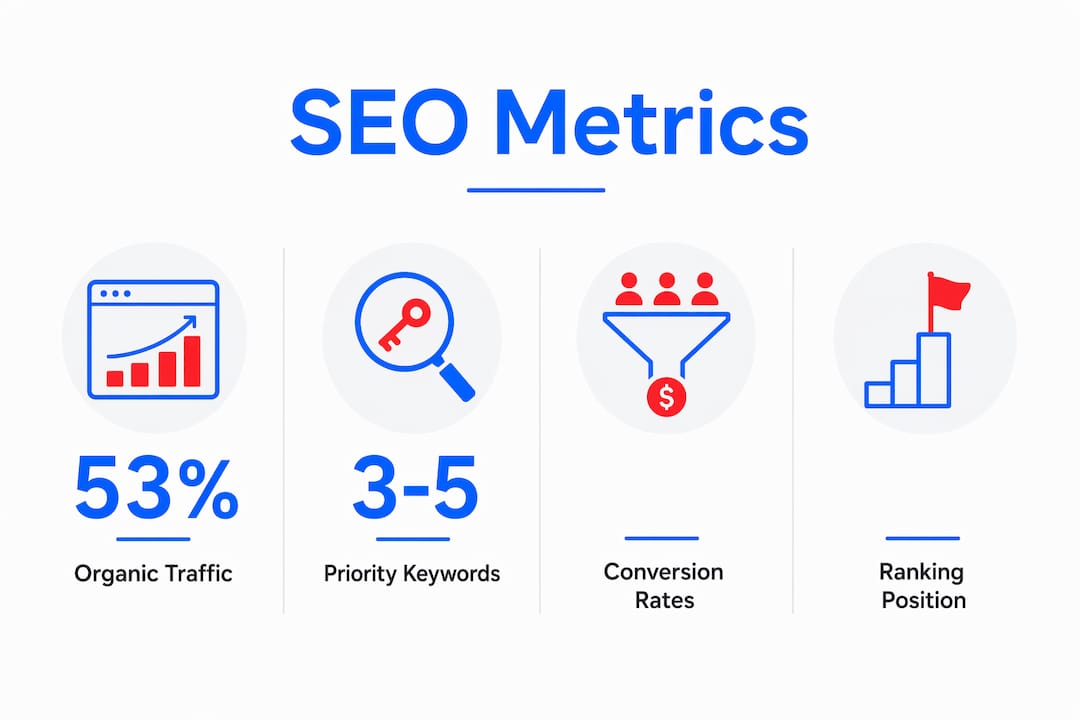
Tracking the right numbers is what separates businesses that improve from those that guess. The table below maps each key metric to its meaning and where to find it.
| KPI | Why it matters | Where to check |
|---|---|---|
| Organic sessions | Total visits from unpaid search; your baseline growth indicator | GA4 > Acquisition > Traffic Acquisition |
| Impressions | How often your pages appear in search results, even without a click | Google Search Console > Performance |
| Average position | Your typical ranking for tracked keywords | Google Search Console > Performance |
| Click-through rate (CTR) | The percentage of impressions that become clicks; signals title/meta effectiveness | Google Search Console > Performance |
| Conversions (calls, form fills, bookings) | The actual business outcomes from organic traffic | GA4 > Conversions; GBP Insights |
| Landing page engagement | Time on page and scroll depth; shows whether content matches intent | GA4 > Engagement > Landing Pages |
| Backlinks and index coverage | Domain authority signals and whether your pages are being indexed | Google Search Console > Coverage; Ahrefs free tools |
Two benchmarks worth knowing: organic search drives around 53% of all website traffic across industries, so if your organic share is significantly lower, there’s room to grow. The top organic result on Google typically earns a substantially higher CTR than positions two and three combined, which is why ranking on page one, not just page two, changes your lead volume materially.
Connect Search Console to GA4 so you can see which organic landing pages are producing conversions, not just clicks. That single setup step is what turns raw traffic data into business intelligence. Business Queensland’s SEO guidance recommends tracking conversion rate, time on page, impressions, ranking, bounce rate, and CTR as your core reporting set.
Work through these in order. The first tasks deliver the fastest results with the least effort; the later ones build the compounding value that pays off over months and years.
Mini template: 3-step GBP optimisation
Pro Tip: Start with GBP and mobile speed in week one. The early wins from local visibility often generate enough enquiries to justify investing in longer-term content work, so let the first results fund the next phase.
For a broader look at website optimisation for service businesses, the 2026 guide covers the technical and content elements together.
SEO has an “invisible phase” that catches many business owners off guard. Technical fixes and content foundations are laid in the first few months before visible lead flow begins. Planning for this is what separates businesses that stick with it long enough to see results from those that abandon it too early.
| Phase | Typical timeframe | What happens |
|---|---|---|
| Foundation | Weeks 1–6 | GBP claimed, technical fixes, top pages optimised |
| First signals | Months 2–4 | Impressions rise, some keywords enter page 2–3 |
| Visible lead flow | Months 4–6 | Rankings reach page 1 for local/niche terms, calls increase |
| Compounding growth | Months 9–18+ | Multiple keywords ranking, content driving consistent leads |
Cost varies significantly by approach. Doing it yourself with workshop-based training sits at the lower end of the investment spectrum; hiring a specialist for ongoing work sits at the higher end. One-off technical fixes or a content sprint fall somewhere in between. The key variable isn’t the dollar amount, it’s consistency. Sporadic effort produces sporadic results.
Mature SEO campaigns typically deliver a lower cost per lead than Google Ads, but break-even usually occurs several months after launch. That’s why the most practical approach for small service businesses is to run paid ads for immediate leads while organic builds, then gradually shift budget as organic rankings start converting. The Drive Traffic & Get Clicks workshop covers exactly this paid-plus-organic approach.
Pro Tip: Budget for a 3–8 month runway before expecting SEO to carry your lead generation. Use paid campaigns during that period to validate which keywords actually convert, then prioritise those terms for your organic content.
Three setup steps give you a reliable measurement foundation. First, connect Google Search Console to GA4 inside the GA4 property settings. Second, confirm your organic channel grouping is correctly separating organic search from paid and referral traffic. Third, configure conversion events in GA4 for the actions that matter: phone call clicks, form submissions, and booking completions.
With that in place, run these reports monthly:
For weekly tracking, monitor your ranking for three to five priority keywords using a simple rank tracker. Google Search Console’s average position metric is free and sufficient for most small businesses starting out. One attribution quirk worth knowing: GA4’s default attribution model may credit a later touchpoint (like a direct visit) for a conversion that organic search initiated. Check your assisted conversions report to see the full picture.
Tools: GA4 for traffic and conversion data, Google Search Console for rankings and indexing, and a basic rank tracker for weekly keyword monitoring. The website conversion optimisation guide pairs well with this measurement setup to ensure the traffic you’re generating is actually converting.
Most small business SEO problems come down to a handful of recurring errors. Recognising them early saves months of wasted effort.
Red flags to watch in Search Console: a sudden drop in impressions across many pages (often signals a Google algorithm update or an indexing issue), a high number of “Excluded” pages in the Coverage report (pages Google isn’t indexing), and a sharp CTR decline on previously strong pages (title or meta description may need refreshing).
If time is limited, fix in this order: GBP completeness, mobile speed, NAP consistency, then service page optimisation.
Mybworkshops works with Australian service-based business owners through a structured three-phase programme that moves from diagnosis to implementation to scaling. The approach is practical and hands-on, built for owners who want to understand what they’re doing and why, not just follow a checklist blindly.
Phase 1: Diagnose. Participants audit their current website, GBP, and keyword visibility to identify exactly where traffic is being lost. Typical outcome: a clear priority list of fixes that will move the needle fastest.
Phase 2: Implement. Owners work through on-page optimisation, GBP setup, local schema, and content planning using structured templates and AI prompts. Typical outcome: service pages optimised for local intent, GBP fully completed, and a content plan in place.
Phase 3: Scale. With foundations set, participants build a repeatable content and review system, connect GA4 and Search Console for ongoing measurement, and learn how to pair paid campaigns with organic for maximum efficiency. Typical outcome: more calls from organic search, higher conversion rates on key pages, and lower cost per lead as organic traffic grows.
Client examples and outcomes show what this looks like in practice across different service industries. Owners ready for guided implementation can explore the full workshops programme to find the right starting point.
SEO drives sustainable website traffic by building organic visibility that compounds over time, making it the most cost-efficient long-term lead generation channel for Australian service businesses.
| Point | Details |
|---|---|
| Organic traffic dominates | Organic search drives around 53% of all website traffic, making it the largest single channel. |
| Local SEO converts fastest | A complete Google Business Profile and consistent NAP across directories are the quickest wins for service businesses. |
| SEO compounds; ads don’t | Content, backlinks, and schema keep generating leads long after the initial work, unlike paid ads that stop when spend stops. |
| Measure conversions, not just visits | Connect GA4 and Search Console to track calls, form fills, and bookings from organic traffic, not just page views. |
| Plan for a 3–8 month runway | Visible lead flow typically begins at months 4–6; budget accordingly and use paid ads to bridge the gap. |
One-week action plan:
Start measuring from day one. Even a basic Search Console report run at the end of week one gives you a baseline to compare against next month. For more hands-on guidance on boosting website traffic for service businesses, the Mybworkshops resource library has practical templates and step-by-step guides.
These are the most useful official and industry resources for Australian service businesses working on SEO:
Yes. Organic search drives around 53% of all website traffic across industries, and improving your rankings directly increases the volume of visitors arriving without paid spend.
SEO is evolving, not declining. Demand for trusted, authoritative content remains strong, and new formats like AI-generated search summaries reward the same signals, clear answers, structured data, and genuine expertise, that good SEO has always required.
SEO shapes what content you create, how you structure it, and which questions it answers. Content optimised for search intent attracts visitors who are already looking for your service, making it far more likely to generate enquiries than content written without a keyword or audience focus.
The 3 C’s of SEO are commonly described as Content (relevant, intent-driven pages), Code (technical site health and structured data), and Credibility (backlinks and authority signals). Together they determine how well your site ranks and how much organic traffic it attracts.