

Your pricing strategy determines whether your early business attracts the right customers, covers its true costs, and holds a credible position in the market. As Business, matching your pricing to your business goals and reviewing it regularly is the foundation of a sustainable model. This week, your first moves are: set one clear pricing goal, calculate your true cost floor (including your own time), display prices GST-inclusive from day one, and run at least one small price test before you commit to a permanent number.
Pricing is a strategic tool that positions your brand and shapes every part of your business, from the customers you attract to the margins you keep. Treating it as bookkeeping is the most common and costly mistake early founders make.
Pricing strategy is the single lever in an early business that simultaneously determines profitability, customer quality, and brand position, making it the first system worth building properly.
| Point | Details |
|---|---|
| Set one clear pricing goal | Choose margin, penetration, or positioning as your primary goal before picking a number. |
| Calculate your true cost floor | Include non-billable hours (admin, marketing, onboarding) or your floor will be too low. |
| Display prices GST-inclusive | Required under ACCC rules for consumer-facing prices; register for GST at $75,000 turnover. |
| Test before you commit | Run a four to eight week pilot, measure conversion and margin, then scale or adjust. |
| Mybworkshops | Provides pricing templates, checklists, and live workshops to build pricing into your business system. |
The role of pricing strategy in an early business goes well beyond covering costs. Your price is the first signal a potential customer reads about your quality, your positioning, and whether you are the right fit for them. Set it too low and you attract price-sensitive buyers who churn quickly and resist any future increase. Set it too high without a clear value story and you lose sales before the conversation starts.
Three things your pricing decides from day one:
The ACCC sets rules on how prices must be displayed to consumers, including surcharging rules. The ATO requires GST registration once your annual turnover reaches $75,000. And business.gov.au provides practical checklists for choosing and reviewing your approach. Getting these foundations right in week one means you are building on solid ground rather than patching problems later.
Vague goals produce vague prices. Before you pick a number, decide what your price needs to achieve.
The most useful pricing goals for early-stage businesses fall into four categories:
ANZ’s business guidance recommends factoring pricing objectives into your wider business and marketing plan so that price supports goals like brand reputation, market share, and sales velocity rather than working against them.
Translate your goal into a measurable target. A growth-first founder might target 20 new clients in 60 days at a break-even price, with a planned increase at day 61. Both are valid. What matters is that the goal is specific enough to test.
Pro Tip: Pick one primary pricing goal and one secondary metric. If your primary goal is margin and your secondary is conversion rate, you can run a price test and read the result clearly. Trying to optimise for margin, volume, and brand positioning simultaneously produces mixed signals and no useful data.
You do not need a formal research budget. You need five to ten conversations and a few hours of competitive observation.
Customer interviews are the fastest way to understand willingness to pay. Ask open questions: “What have you paid for this kind of help before?” and “What would make you feel this was worth twice the price?” You are not asking customers to set your price; you are mapping the range of what feels reasonable to them.
A simplified version of van Westendorp price sensitivity questions works well for small businesses. Ask four questions: at what price would this feel too cheap to trust? Too expensive to consider? Expensive but worth it? Good value? The overlap between “expensive but worth it” and “good value” is your initial target zone.
Competitor price sweeps take less than an hour. Map three to five competitors by price point, delivery model, and visible value-adds (what is included, what is extra). Do not copy their price. Understand where you sit relative to them and why. A competitor charging more may be doing so because of a stronger brand, a longer track record, or a bundled guarantee. Those are the gaps you need to close or the advantages you need to articulate.
Business Victoria recommends combining different pricing approaches and mapping what customers will pay before committing to a model. Pre-orders, waitlists, and early-access sign-ups are also demand signals worth watching: a waitlist tells you demand exceeds supply at your current price, which is a strong argument for raising it.
Quick research checklist before launch:
There are seven approaches worth knowing. Most early-stage businesses use one as a primary model and layer in elements of a second.
| Strategy | Best for | Early-stage pros | Red flags |
|---|---|---|---|
| Cost-plus | Product businesses with clear COGS | Simple to calculate | Ignores value; often undercharges |
| Value-based | Service businesses, consulting, coaching | Higher margins; scales with efficiency | Requires strong value articulation |
| Penetration | Competitive markets; fast customer acquisition | Builds volume quickly | Anchors customers to low prices |
| Skimming | Innovative or first-mover products | Maximises early revenue | Requires genuine differentiation |
| Premium | Positioning-led brands; high-touch services | Attracts quality clients; protects margin | Needs brand credibility to hold |
| Competitive | Commodity services; price-sensitive markets | Easy to justify to customers | Race to the bottom risk |
| Time/usage pricing | Hourly services, SaaS, project work | Transparent; easy to scope | Penalises efficiency; caps income |
SmartCompany notes that cost-plus mark-up pricing is the default for most Australian startups, and it frequently causes under-charging or leaves profit on the table. Value-based pricing, which focuses on the economic benefit to the customer rather than time spent, allows higher margins as you become more efficient.
Practical use cases:
The most resilient early-stage model is a value-based core with a time-limited penetration offer for early adopters, provided the offer has a clear end date and a published transition price.
Your price has a floor and a ceiling. The floor is your true cost. The ceiling is what the market will pay. Your job is to find the most defensible position between them.
True cost accounting is where most service businesses go wrong. Direct costs (materials, software, subcontractors) are easy to see. Indirect overheads (rent, insurance, subscriptions) are usually included. What founders consistently miss is their own non-billable time: administration, client acquisition, onboarding, post-sale support, and professional development. The ATO advises including an allocation for these hours when calculating your realistic hourly floor. If you spend 20 hours a week on non-billable work and only bill 20 hours, your effective hourly rate is half what your invoice says.

Channel and delivery effects change your net margin significantly. Selling direct through your own website preserves the full margin. Working through a referral partner or reseller may involve a commission. Each channel requires a different price to achieve the same net return.
Brand positioning is a pricing lever, not just a marketing concept. A higher price, held consistently, signals quality and attracts clients who are less likely to haggle, less likely to churn, and more likely to refer. Early marketing strategy for service businesses reinforces this: your price and your brand message need to tell the same story.
Operational constraints set a practical ceiling on volume. If you can deliver 15 client projects per month at full quality, pricing that generates 30 enquiries per month creates a fulfilment problem. Price to match your capacity, not just your ambition.
Margin vs markup: These are not the same calculation. Markup is profit divided by cost. Margin is profit divided by revenue. A 50% markup on a $100 cost gives you a $150 price and a 33% margin, not a 50% margin. Using the wrong formula when setting targets can mean you are operating at a lower margin than you think.
Testing a price before you lock it in reduces risk and gives you real data instead of assumptions. The process does not need to be complicated.
A minimum viable pricing experiment looks like this:
Week 0–8 test plan:
Scalesuite notes that testing price changes with a small cohort reduces risk and gives clear metrics to decide whether to scale or roll back. Early-adopter pricing works well when it has a visible end date and a published transition price. SmartCompany warns that anchoring customers to a low introductory price without a clear expiry makes later increases feel like a betrayal rather than a natural progression.
Key metrics to monitor throughout:
For promotional experiments tied to pricing, document each test with a hypothesis, result, and next action so you build a pricing decision record over time rather than relying on memory.
Two regulatory requirements affect every Australian business that sells to consumers: GST and the ACCC’s price display rules.
GST at a glance: GST is 10% on most goods and services in Australia. Registration is mandatory once your annual turnover reaches or exceeds $75,000. Taxi and ride-sharing operators must register regardless of turnover.
Once you are registered, you must charge GST on taxable supplies and remit it to the ATO via your Business Activity Statement (BAS).
The ACCC’s guidance on setting prices requires that the single price you display to consumers must be the total price they will pay, including GST and any unavoidable fees. Surcharges for payment methods (credit cards, BNPL) must be disclosed clearly and cannot exceed your actual cost of accepting that payment. Displaying a price ex-GST in a consumer-facing context and adding it at checkout is not compliant with ACCC requirements.
Practical steps:
Pricing is not a one-time decision. Business Victoria recommends reviewing your pricing strategy roughly every three months to stay aligned with market conditions.
Recommended review cadence:
Triggers that should prompt an immediate review:
Communicating price changes to customers requires notice, a clear reason, and where possible, added value. Give existing clients at least 30 days’ notice for a price increase. Offer a grandfathered rate for a defined period if the increase is significant. Frame the change around what has improved, not just what costs more. Clients who understand the reason for an increase are far more likely to stay than those who receive an unexplained invoice revision.
Markup vs margin:
Contribution margin:
Break-even:
Hourly service: You spend 30 billable hours per week and 20 non-billable hours. Your total weekly cost (salary equivalent, overheads, software) is $1,500. Your true hourly floor is $1,500 ÷ 30 = $50.
Fixed-fee package: A website audit package costs you $400 in direct time and tools. Price = $400 ÷ (1 − 0.65) = $1,143. Round to $1,200 for a clean number that still exceeds your margin target.
| Formula | When to use it | Inputs required |
|---|---|---|
| Markup | Setting a price above cost | Cost price, desired markup % |
| Margin | Checking profitability of a price | Selling price, cost price |
| Contribution margin | Evaluating variable-cost offers | Revenue, variable costs |
| Break-even | Validating a new price or package | Fixed costs, contribution margin per unit |
Implementation checklist before updating prices:
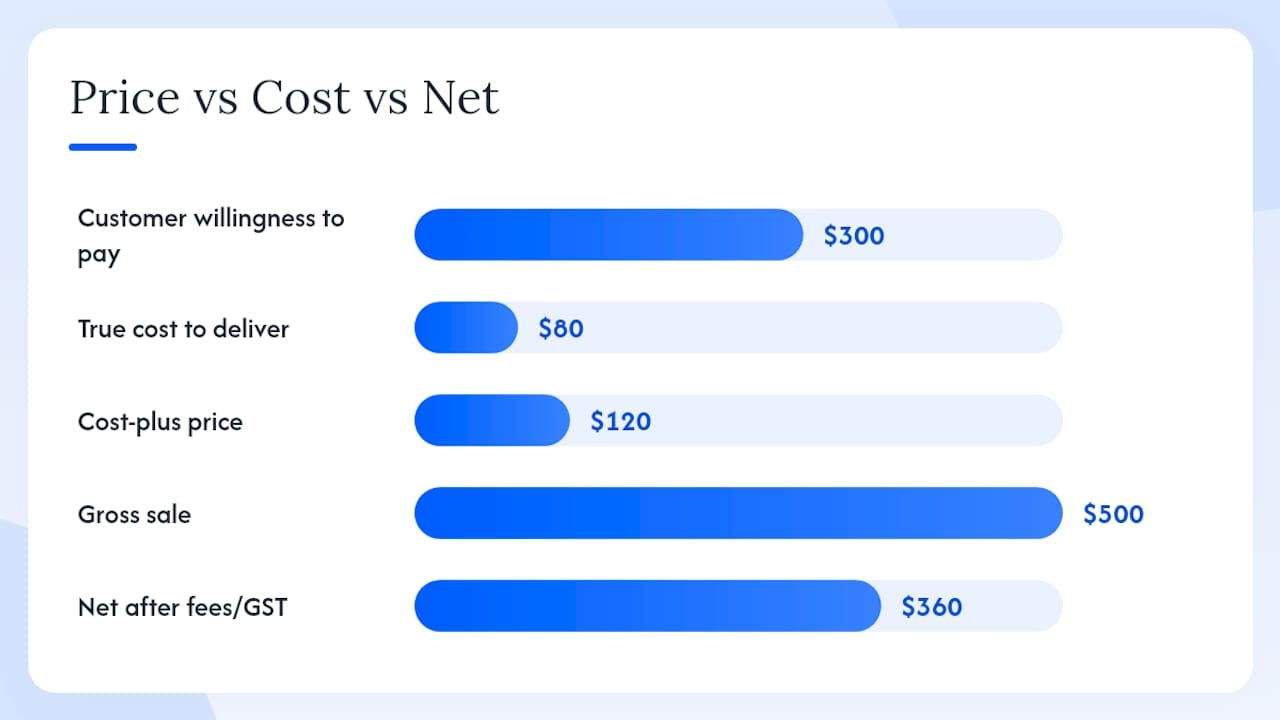
SmartCompany’s analysis of startup pricing identifies cost-plus as the default method for most early businesses, and the one most likely to leave money on the table. But it is rarely the only mistake.
The most common pricing errors:
Red flags in your data that signal a pricing problem:
Quick fixes:
Pricing confidence does not come from picking the right number once. It comes from having a repeatable process that you run regularly and improve over time.
Step 1: Define your goals. Before every pricing decision, state what the price needs to achieve. Margin target, conversion target, customer type, or positioning signal. Write it down. A decision without a documented goal cannot be evaluated later.
Step 2: Validate value through tests. Run a structured experiment before committing. State the hypothesis, choose the sample, measure conversion and margin, and set a decision threshold. Document the result regardless of outcome. A failed test is as useful as a successful one if you record what you learned.
Step 3: Operationalise pricing. Build pricing into your systems, not just your spreadsheet. This means proposal templates with pricing rules baked in, a pricing decision record you update quarterly, and a calendar reminder for your 30, 90, and 180-day reviews.
A pricing decision record captures: the hypothesis, the experiment design, the result, and the next action. It takes five minutes to complete and prevents you from making the same mistake twice. Over 12 months, it becomes a clear picture of what your market will pay and why.
Integrating pricing into a regular review cadence, as part of your broader business strategy rather than as a standalone task, reduces the anxiety that comes with raising prices. When you have data showing that your last price increase did not reduce conversion, the next one feels straightforward. The Mybworkshops business strategy workshop is built around exactly this kind of structured, repeatable decision-making for service-based business owners.
Pricing is one of the decisions that feels personal but needs to be treated as a system. Mybworkshops workshops give service-based business owners the practical tools to do that: pricing templates, implementation checklists, live guidance on offer framing, and peer feedback from other founders working through the same decisions.

The difference between a founder who raises prices confidently and one who avoids the conversation is usually not knowledge. It is having a tested process and a community that has done it before. Mybworkshops’s structured programme moves you from “I think my price is about right” to “I know my price is right because I tested it, documented it, and it holds up against my costs and my market.”
If you are ready to build pricing into your broader business strategy, the Mybworkshops workshops programme covers offer design, value articulation, and pricing implementation as part of a complete business-building system. For founders who want a low-friction starting point, the free masterclass is the fastest way to see the framework in action before committing to a full workshop.
These Australian sources cover the regulatory and practical details referenced throughout this article:
Pricing strategy determines your profitability, the type of customers you attract, and the brand position you can credibly hold. Getting it right early means you avoid the common trap of anchoring customers to a price that cannot sustain the business.
The seven most relevant approaches are cost-plus, value-based, penetration, skimming, premium, competitive, and time or usage-based pricing. Most early-stage service businesses benefit from a value-based core with a time-limited penetration offer for their first cohort of clients.
Price filters your customer base, signals your brand quality, and directly sets your margin. A price that is too low attracts high-maintenance, price-sensitive clients and limits your capacity to reinvest in growth; a price aligned to your value attracts clients who stay longer and refer more.
GST registration is mandatory once your annual turnover reaches $75,000.
Business Victoria recommends reviewing your pricing roughly every three months. Beyond that cadence, review immediately when your costs change significantly, a competitor exits the market, or you add a meaningful new service element.