Marketing sprint planning is a short, time-boxed process that sets a single sprint goal and a committed sprint backlog so your team can run focused, measurable campaign work every one to two weeks. It replaces vague to-do lists with a clear plan, a defined outcome, and a way to measure what worked. By the end of this guide, you’ll know how to run a sprint planning meeting and start your first sprint this week.
TL;DR:
- Use one week cycles for fast tests and two week cycles when marketing work competes with other duties; reserve 12 week programs for larger initiatives.
- Commit to roughly 80% of estimated capacity, especially early on; adding a stretch task later is easier than recovering from overcommitment.
- Choose a primary goal metric and one or two supporting measures; treat results after two weeks as directional evidence, not proof of causation.
A marketing sprint is a fixed period, typically a short cycle of one or two weeks, where your team commits to a specific goal and a defined set of tasks instead of juggling an open-ended campaign calendar. Traditional marketing cycles often stretch across months with loosely connected deliverables; a sprint narrows that scope so everyone works toward one outcome at a time.
This structure borrows from Scrum, a framework originally built for software teams but increasingly adapted for marketing because it solves a problem most small teams know well: too many tasks, not enough clarity on what matters most this week. A practical guide to Scrum for marketing teams notes that sprint-based work improves collaboration and delivery when teams combine a visible backlog with the standard Scrum events, adapted for marketing.
The benefits show up quickly once a team adopts sprints:
Sprints work well for campaign launches, rapid experiments (testing ad creative, landing page variants, email subject lines) and short optimisation bursts where you need quick feedback. For larger initiatives, such as a full rebrand or an annual strategy reset, a longer planning horizon, like a 12-week program increment, suits the work better. We’ll cover how those two timeframes fit together next.
Sprint planning doesn’t happen in isolation. It sits inside a larger cadence that starts with a prioritised backlog, moves through two-week (or similar) sprints, and periodically zooms out to quarterly or program-level planning. Large Australian organisations, including government departments, have used this layered approach successfully: one case describes a department running 12-week Program Increments broken into two-week sprints, with planning events used to align stakeholders and prioritise features using Cost of Delay voting.
For a marketing team, the same logic applies at a smaller scale. Your broader strategy, whether that’s a quarterly campaign plan or an annual marketing budget, sets the direction. Sprint planning is where that direction gets translated into a specific, achievable goal for the next one or two weeks.
To make that translation work, your sprint goal needs to trace back to a business objective. If the quarterly goal is “grow qualified leads by a meaningful margin,” a sprint goal might be “launch and test two lead magnet variants on the homepage.” The sprint goal should be a sentence a junior team member could repeat without checking notes.
When prioritising which backlog items to pull into a sprint, three lenses help:
Items that score well on impact and cost of delay, but modestly on effort, are usually the strongest sprint candidates.
A sprint planning meeting is one event with three topics to work through: why this sprint matters, what you’ll do, and how you’ll do it. This structure comes directly from the Scrum Guide, which defines Sprint Planning as addressing the sprint goal (why), the selected backlog items (what), and the implementation plan (how). For marketing teams, that translates into a focused one-hour session rather than a sprawling status meeting.
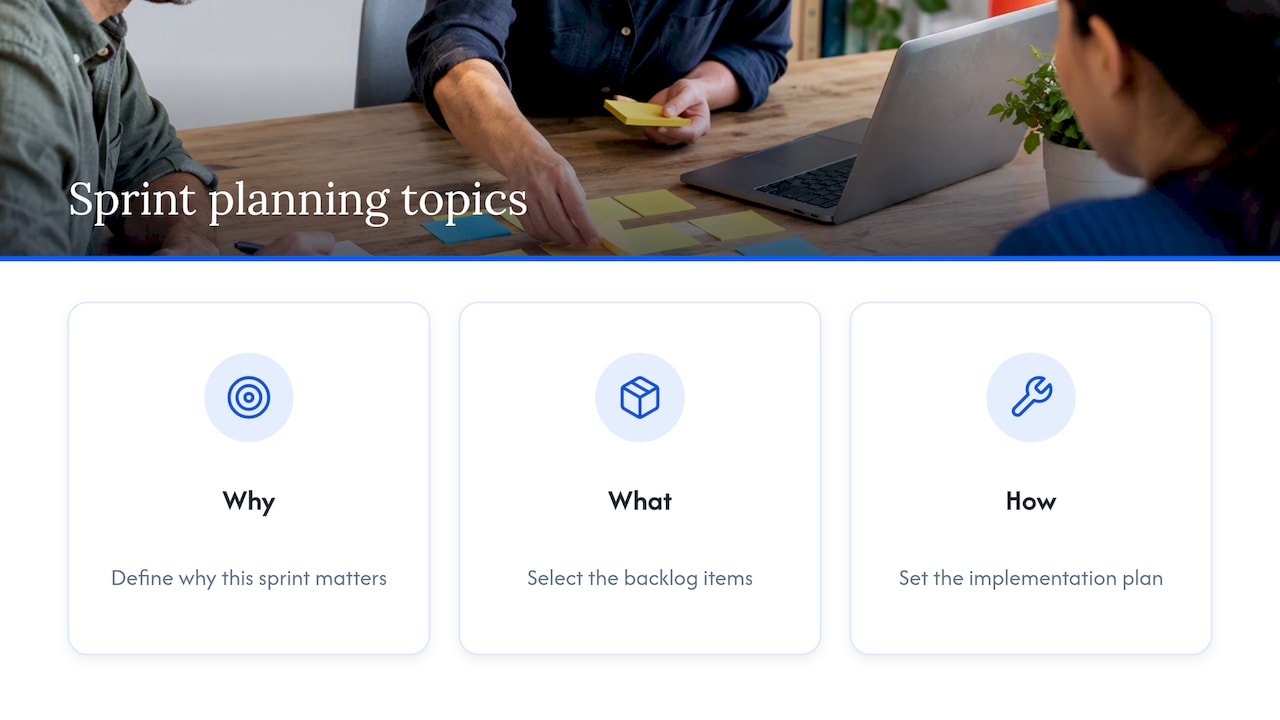
Start by agreeing on the single outcome this sprint exists to achieve. The Scrum Guide treats the sprint goal as the one element that stays fixed once the sprint begins, even as the team negotiates scope day to day. For marketing, that might mean: “Validate whether a revised offer page increases trial sign-ups.” Everything else in the meeting serves this goal.
Once the goal is clear, pull in backlog items that directly support it. This is where preparation matters: items should already meet your “ready” criteria (clear description, acceptance criteria, rough size estimate) before the meeting, not get defined on the spot. A messy backlog turns a one-hour planning session into a two-hour negotiation.
For each selected item, the team breaks the work into tasks small enough to finish in a day or less. The Scrum Guide notes that decomposing backlog items into granular, often one-day tasks improves daily planning and makes the Daily Scrum a genuine working session rather than a status update. For a marketing sprint, a backlog item like “launch new landing page” might break into: write copy, design layout, set up tracking, QA links, schedule publish.
Walking in unprepared is the single biggest reason planning sessions run long. Before the meeting, make sure you have a backlog with ready items, a rough estimate of team capacity for the sprint (based on past sprints, if you’ve run any), and a shared understanding of the sprint length, typically one or two weeks.
Capacity estimation doesn’t need to be complicated. Many marketing teams use simple story points (small, medium, large) rather than hours, because campaign work is rarely predictable to the minute. If your team previously completed three medium-sized tasks and one large task in a two-week sprint, that’s your rough velocity for planning the next one. Timeboxing matters just as much as sizing: a task without a clear end date tends to expand to fill the whole sprint, so set a hard deadline for each task inside the sprint window.
Pro Tip: Keep your first few sprints deliberately light on scope. It’s easier to add a stretch task mid-sprint than to recover from overcommitting in week one.
By the end of sprint planning, you should walk away with a written sprint goal, a sprint backlog of decomposed tasks with named owners, a shared definition of “done” for each task, and a board (physical or digital) set up to track progress. Google’s Agile Essentials course covers this same combination of backlog creation, estimation and sprint planning as core skills for teams adopting agile ways of working.
Running your first sprint doesn’t require weeks of preparation. With a backlog, a rough idea of capacity, and a defined sprint length, you can be running a sprint within a week.
Before you start, confirm these five things:
With those in place, follow five steps:
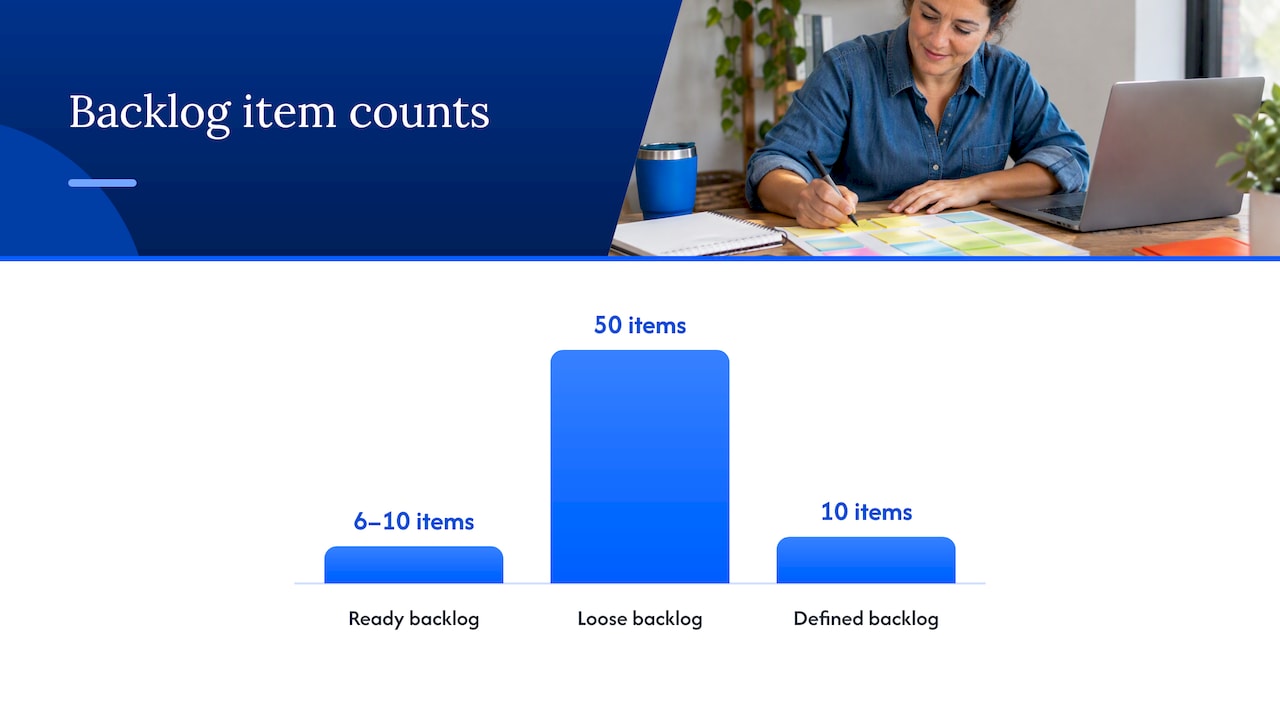
A few practical notes on each step make the difference between a sprint that sticks and one that fizzles out after a fortnight. When prepping the backlog, resist the urge to add every idea your team has ever discussed; a backlog with fifty loosely defined items is harder to prioritise than one with ten well-defined ones. When running the planning meeting itself, timebox it: sixty minutes for a one-week sprint is usually enough once the backlog is in good shape.
Daily stand-ups work best when they stay anchored to the sprint goal rather than becoming a list of individual activities. A useful question to ask each day: “Is anything blocking us from reaching the sprint goal?” That single question surfaces problems faster than a round-robin status update.
The sprint review doesn’t need to be a formal presentation. A short walkthrough of what you tested, what the data showed, and what you’d do differently is enough to close the loop and inform the next sprint’s backlog.
A sprint succeeds or fails against its goal, not against a generic list of marketing metrics. Pick one primary metric that directly reflects the sprint goal, plus one or two supporting metrics that add context.
Common metrics worth tracking, depending on the sprint’s focus:
A two-week sprint rarely proves long-term causation. Sprint planning guidance for marketers notes that time-boxed iterations help teams estimate capacity and prioritise against business objectives, which improves alignment, but a short sprint is better suited to directional signals than to definitive proof. Treat a positive result as a reason to run a larger test, not as final confirmation.
A simple sprint review template keeps reporting consistent: what we set out to do (the goal), what we shipped, what the data showed, what we learned, and what moves into the next backlog as a result. Keeping this lightweight, a one-page summary rather than a lengthy deck, means the team actually uses it sprint after sprint.
Most teams that abandon sprint planning run into the same handful of problems, and all of them have straightforward fixes.
A written social contract also helps. Guidance from an Australian government case study on sprint adoption notes that a team agreement covering meeting times, decision-making and communication norms improves predictability and reduces friction during sprints, a lesson that applies just as well to a five-person marketing team as to a large department.
For remote or small teams, keep the format light: a fixed daily check-in time, async written updates when live meetings aren’t practical, and one shared board as the single source of truth for what’s in progress.
Pro Tip: If your team is new to sprints, run one full cycle, planning through review, before judging whether the format works. The first sprint is always about learning the rhythm, not hitting a perfect result.
Reading about sprint planning is one thing; running it consistently with a small team is another. Our Business Strategy Workshop and Lead Generation System Workshop both include practical templates you can adapt into a sprint backlog, so you’re not building a system from a blank page.
Our workshops are structured in actionable phases that mirror the cadence described in this guide: a strategic direction first, then focused execution work broken into manageable pieces. Buyers of our workshops gain 12 months of access to materials and live Q&A opportunities, which matters for sprint planning specifically, since the first few cycles usually raise questions that are easier to resolve with direct support than by troubleshooting alone. Our three-phase marketing plan explains how this structure ties shorter execution cycles back to a longer strategic arc.
A marketing backlog is the full list of campaign ideas, experiments and tasks your team could work on, ranked by priority rather than by the order they were dreamed up. Without ready criteria, backlogs become dumping grounds: a mix of fully-formed briefs and half-remembered ideas that nobody can actually act on in a planning meeting.
Ready criteria give every item a minimum bar before it’s eligible for a sprint. For most marketing teams, that means:
Items that don’t meet these criteria stay in backlog refinement until they do, rather than getting dragged into a planning meeting unprepared. This single discipline, refining the backlog before planning rather than during it, is often the difference between a sixty-minute planning session and one that drags on for two hours. Backlog refinement works best as a short, separate session, ideally mid-sprint, so the next sprint always starts with a shortlist of ready items rather than a scramble to define them on the spot.
You don’t need expensive software to run a marketing sprint, but you do need somewhere visible to track it. A Kanban-style board, with columns for “backlog,” “in progress,” “review” and “done,” gives the whole team a shared view of where every task stands without needing a status meeting to find out.
Practical Scrum guidance for marketing teams recommends keeping visualisation tools and planning artefacts lightweight: a one-page board and a short evidence pack for reviews reduce ceremony while still keeping the team accountable. That principle holds whether you’re using a whiteboard, a spreadsheet, or dedicated software.
For teams that want a single place to manage sprint backlogs alongside broader business planning, tools like LifeDesk’s marketing planner let you host a visual backlog and sprint board without juggling multiple apps for tasks, goals and campaign work. Whatever tool you choose, the test is simple: can anyone on the team glance at the board and know what’s happening, without asking?
A sprint that isn’t connected to your broader strategy is just busywork with a deadline attached. Before any sprint goal gets written, it should trace back to a specific business objective, whether that’s revenue growth, lead volume, brand awareness or client retention.
The clearest way to keep this alignment is to review your quarterly or annual plan before each backlog refinement session and ask: which of these priorities needs attention in the next sprint? This keeps sprints from drifting toward whatever feels urgent that week instead of what actually moves the business forward.
Our three-phase marketing plan is built around this same logic: a strategic foundation sets direction, and shorter execution cycles, like sprints, carry that direction into specific, measurable work. When a sprint goal and a business goal line up clearly, reporting on sprint outcomes becomes straightforward, because you’re already tracking the metric that matters to the business, not inventing a new one for the sprint alone.
Sprint length depends on team size, campaign type and how quickly you need feedback. A few common patterns:
Most small marketing teams find two-week sprints the easiest starting point: long enough to finish meaningful work, short enough to course-correct quickly if the goal isn’t being met. Once a team has run several successful two-week sprints, some shift to a quarterly rhythm with sprints nested inside it, similar in spirit to the program increment model, without needing the full formality of a large enterprise rollout.
A sprint without a feedback loop is just a deadline. The value of running work in short cycles comes from reviewing what happened and changing the next cycle based on it, not from the time-box alone.
Two feedback points matter most. The sprint review looks at what shipped against the sprint goal and what the data showed, feeding directly into backlog priorities. Updated Scrum guidance also frames the daily check-in as a short planning event focused on progress toward the goal, not a status report, which means it’s also a feedback point: if something isn’t working, the team adjusts that day rather than waiting until the review.
The retrospective is where process improvements happen, separate from the review’s focus on outcomes. A short retrospective asking “what slowed us down, and what should we change next sprint?” keeps the process itself improving alongside the work. Teams that skip this step often repeat the same planning mistakes, overcommitting, unclear goals, sprints that drift into becoming task lists, sprint after sprint, because nobody set aside time to name the problem.
Feeding these learnings back into the backlog closes the loop: a sprint that revealed a landing page issue should produce a new backlog item to fix it, not just a note in a document nobody revisits.
Reading through a framework is a useful start, but the teams that stick with sprint planning are the ones who build it into a documented business system rather than treating it as a one-off experiment. We designed our workshops to give service-based business owners exactly that: a structured path from strategy to repeatable execution.

A few workshops are especially relevant if sprint planning is where you’re starting:
Participants leave with practical templates, a documented backlog, and 12 months of access to materials and live Q&A support, so the sprint cadence you build doesn’t fall apart after the first few cycles. If you’re not sure where to start, our free masterclass is a straightforward way to see how the three-phase approach fits your business before committing to a workshop.
The 3-5-3 rule describes Scrum’s basic structure: three roles (product owner, Scrum master, development team), five events (sprint, sprint planning, daily scrum, sprint review, retrospective), and three artefacts (product backlog, sprint backlog, increment). It’s a memory aid for the framework’s core components rather than a strict rule to follow.
A typical sprint moves through backlog refinement, sprint planning, daily execution with stand-ups, sprint review, and retrospective. Each stage feeds into the next, with the retrospective’s learnings flowing back into backlog refinement for the following sprint.
Scrum remains widely used because its core structure, a fixed goal, a short time-box and regular review, solves a problem that doesn’t go away: the need to prioritise and ship work in manageable chunks. Marketing teams continue adapting it specifically because the Sprint Planning structure of why, what and how works just as well for campaign work as it does for software.
Marketing plan frameworks vary, but a common version covers: setting objectives, researching your market, defining your audience, developing strategy, planning tactics, allocating budget and resources, and reviewing results. Sprint planning fits inside the tactics and execution stages, turning the broader plan into short, measurable cycles of work.
Most small marketing teams run short cycles that are long enough to complete meaningful work but brief enough to adjust quickly if results fall short. Larger initiatives sometimes use longer program increments, typically broken into shorter sprints, a structure used successfully by at least one Australian government department.